3 months ago
23
3 months ago
23
Australians will not see a Russian flag flying when an oil tanker sails into Botany Bay later this month with 78,000 tonnes of petrol. The Proteus Bohemia will look like any other ship arriving to discharge a product that looks the same in every port. The tanker, operated by Shell and flying the Singapore flag, will be nothing special.
But its cargo is tainted by war in Europe. Some even call it blood oil. That’s because almost half the cargo is sourced from Russian crude that delivers valuable tax revenue for the Russian government. By the time it is sold at a petrol pump in Australia, every litre has helped Russian President Vladimir Putin pay for his war in Ukraine.
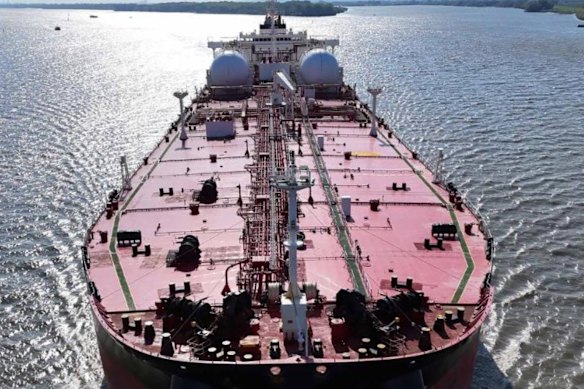
The Proteus Bohemia is due to dock in Sydney at the end of this month.
This is not meant to happen. The official reports from the International Energy Agency say Australia does not import any Russian oil. But the tanks on the Proteus Bohemia tell a different story because they were filled at an Indian refinery that turns Russian crude into Australian petrol.
This oil trade is now the next flashpoint in the Australian debate about the war in Ukraine. Some of our biggest allies are toughening their sanctions on Russia to stop the trade and starve Putin of hard currency, and this raises immediate questions about whether Australia keeps up or falls behind.
US President Donald Trump moved last month to harden the sanctions on the two big Russian oil exporters, Rosneft and Lukoil. He also imposed higher tariffs on India to punish it for taking the Russian crude. The European Union has also sanctioned the Russian companies, although it cannot stop member states like Hungary and Slovakia from taking the oil from pipelines from the east.
The United Kingdom moved one week before Trump by targeting Rosneft and Lukoil, as well as trying to stop more vessels in the “shadow fleet” that helps the Russian exporters dodge the blockade on their products.
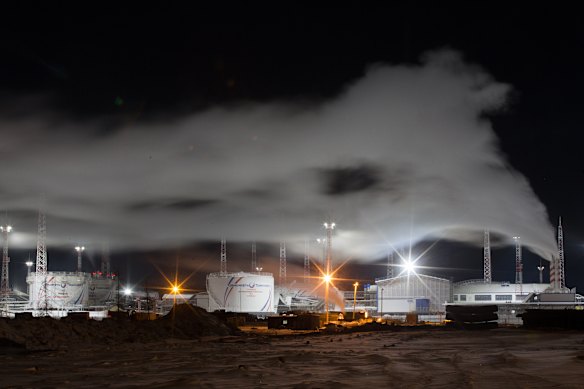
Oil silos on the Russkoye heavy crude oil field, operated by Rosneft PJSC, in the Yamalo-Nenets region of East Siberia.Credit: Bloomberg via Getty Images
“We will act to take Russian oil and gas off the global market,” declared British Prime Minister Keir Starmer on October 25. “We’re choking off funding for Russia’s war machine. I’m urging others to take these steps too, to go further to reduce their dependencies and incentivise third countries to stop buying these tainted resources.”
That sends a message to allies, including Prime Minister Anthony Albanese, a good friend of Starmer. The Australian government is hinting at new measures, including bans on specific companies that refine Russian oil, but it has yet to move.
The Western sanctions are slowing the flow of Russian oil to major markets. But they have not stopped the flow to Australia. The Proteus Bohemia was loaded at the Indian port of Jamnagar on November 10 and, at last check, was crossing the Indian Ocean. Another tanker, the Hafnia Lillesand, loaded 99,600 tonnes of diesel at Jamnagar on November 10. It is heading for the Kwinana refinery near Perth.
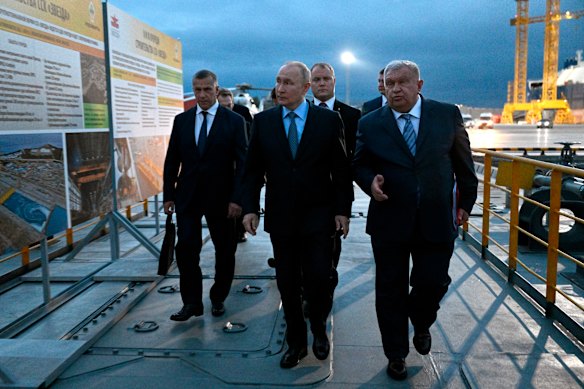
Putin and Rosneft CEO Igor Sechin pictured in far-east Russia in 2023.Credit: AP
How much of our oil comes from Russia?
Russia is not the only source of crude in the Australian trade, of course. But experts can estimate how much of the Russian oil ends up in Australian petrol bowsers, using public data in an industry that tracks every barrel when it is shipped and sold. The key to the calculation is the role of the oil refinery at Jamnagar. Tankers leave its port routinely for Western Australia, Victoria and NSW.
About 47 per cent of the crude going into the Jamnagar refinery was sourced from Russia from January to October this year, according to the Centre for Research on Energy and Clean Air, a European non-profit group that tracks the market. The Indian refineries have been good customers for Russia since the Western sanctions shut down other options after the full-scale Russian invasion of Ukraine in February 2022.
This means the petrol and diesel shipped from Jamnagar to Australia has about the same proportion of Russian fuel – 47 per cent. And Jamnagar, which is the world’s biggest refinery complex, will have trouble changing this. Its owner, Indian giant Reliance Industries, struck a 10-year supply agreement with Rosneft, the sanctioned Russian exporter, last December.
About 90 per cent of Indian oil exports to Australia come from Jamnagar, says CREA analyst Vaibhav Raghunandan. While the US and Europe are trying to reduce the use of Russian oil, Australia is not following.
“Australian imports of oil products refined from Russian crude have surged by 10 per cent in the first nine months of this year,” says Raghunandan. He says the imports declined from September, largely reflecting cuts at the Indian refineries rather than any change in demand from Australia. But he says Australia is an outlier compared to other Western nations.
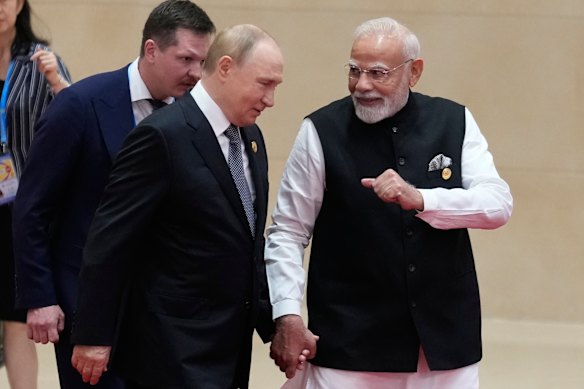
Vladimir Putin and Indian Prime Minister Narendra Modi hold hands at the Shanghai Co-operation Organisation summit in September.Credit: AP
A second refinery is also sending Russian oil to Australia. It is the giant Mangalore facility in southern India. It accounts for the other 10 per cent of Indian shipments to Australia. In September, Australia also received one shipment of diesel from the Paradip refinery on the east coast of India, but this was unusual. A fourth refinery, Vadinar, has supplied Australia in the past. It is majority-owned by Rosneft and was sanctioned by the European Union this year.
The CREA research suggests Australia could halt its use of Russian oil by turning away fuel from Jamnagar and Mangalore.
“All the Australian government has to do, essentially, is to put an embargo on purchases from these two refineries and just do a little bit more investigation and due diligence on your supply chain,” says Raghunandan. “You should be able to eliminate these purchases. The EU has already done this.”
Can Australia trace the tainted oil?
The war in Ukraine has killed and maimed tens of thousands of people, while flattening city blocks and driving millions from their homes. But it has also delivered big profits to oil companies and traders willing to find markets for Russian exports. Western sanctions have tried to stop this by driving down the price of Russian oil, but this also heightens the incentives for those who will skirt the sanctions.

Emergency service workers at the site of a Russian air strike on a residential building in Kyiv, Ukraine, in August.Credit: Bloomberg
Put simply, the Russian oil is cheaper. And the Indian fuel made from Russian crude can undercut others. CREA estimates that companies bringing diesel from India to Australia enjoyed a discount of about 4 per cent compared to the cost of the same product from refineries in South Korea. This calculation is based on the Australian Petroleum Statistics published by the federal government.
“This has resulted in Australian companies benefiting to the tune of $64.3 million, using averaged historical rates, in the first eight months of this year,” says CREA. Behind the profit, however, is the pain of the war. CREA estimates that this oil generated approximately $800 million in revenue for the Kremlin over the same eight months.
Loading
Mark Corrigan, an Australian chemical engineer who is familiar with the oil business and tracks tankers, says there is a moral case to halt the trade.
“While Australia stopped importing Russian oil directly in 2023, our government and oil importers know full well that the backdoor routes to our market are just as lucrative to Russia,” he says.
“Indian refiners like Reliance Industries openly gloat about the money they make using discounted Russian crude, yet that refinery has become our single largest supplier of oil products.
“There is a clear financial trail from Australian bowsers back to the Kremlin. While continuing to trade through these supply points, Australian oil importers remain complicit in Russia’s criminal behaviour in Ukraine.”
What has Australia done?
It looks, at first, like politicians in Canberra have been idle. In fact, Australia has enacted a series of sanctions since Russia’s invasion of Ukraine. It cut direct purchases of Russian oil from $80 million a year to zero. It imposed sanctions on 150 vessels in the “shadow fleet” that transport Russian oil despite global bans, and it joined the US and others in placing a price cap on Russian oil exports to try to starve Putin of revenue.
‘Our fuel importers are aware of their supply chains, they know what they are buying, they are just putting profits above ethics’
Kateryna Argyrou, Australian Federation of Ukrainian OrganisationsBut the oil industry has adapted to these measures. The US, the EU and the UK have toughened their sanctions in response. But Australia is yet to decide how to respond. The only signal from the Department of Foreign Affairs is that it is looking at further sanctions.
“We are evaluating options to place further pressure on Russia’s oil revenues,” says a department spokesperson. “We will continue taking action to deny Russia access to Australia’s markets and ensure Australia does not inadvertently fund Russia’s war machine.”
Foreign Minister Penny Wong argues this is not just for the government to consider. She has called on oil companies to check their supply chains to make sure they are not paying for Russian oil.
“Australians do expect their businesses to ensure that their supply chains don’t inadvertently fund Russia’s illegal and immoral invasion of Ukraine,” Wong told Senate estimates last month. “And business should uphold that responsibility and expectation.”
When CREA looks at the Australian market, it sees companies including Ampol, BP, Caltex, ExxonMobil and Vitol buying fuel from India that is made, at least in part, from Russian oil. This varies over time, and some companies appear to be changing their ways. This article does not assert they are all buying Russian oil. At an industry level, however, the trade continues.
Can it be stopped?
Australia bought about 783,000 tonnes of fuel sourced from Russian crude during 2023, according to CREA analysis. Then, at the very time Canberra said it wanted to sanction Putin, Australia bought even more. The volume rose to 1.5 million tonnes in 2024. So far this year, up to the end of October, it has reached 1.3 million tonnes.
The total is just shy of 3.6 million tonnes since Australia and its allies talked about inflicting financial pain on Putin.
Loading
“Every drop of this oil prolongs the suffering of innocent Ukrainians,” says Kateryna Argyrou, the chair of the Australian Federation of Ukrainian Organisations. “And every dollar we send to the Kremlin enables the funding of weapons that destroy Ukrainian homes and lives.”
The federation calculates, using the CREA numbers, that the Australian demand has delivered $2 billion to the Kremlin over time. That’s more than the $1.5 billion in military and humanitarian aid the Australian government has given Ukraine over more than three years of war.
“Our fuel importers are aware of their supply chains, they know what they are buying, they are just putting profits above ethics,” says Argyrou. “Further, the Albanese government can apply bans at the refinery level, rather than targeting countries as a whole.”
One option is to ban imports from Jamnagar, given it has a public relationship with Rosneft, which is subject to sanctions. Other refineries could be blocked in the same way.
Would prices rise?
Turning away cheaper oil looks like it would lead to higher prices, but Raghunandan says this only works if Australia has to rely on the Indian refineries and cannot go to other suppliers. He estimates that India delivers about 10 per cent of Australia’s petrol and diesel. He notes that India only emerged as a bigger supplier in the past few years, when the Ukrainian war changed the market.
“South Korea is the biggest provider of oil to Australia, and Korean refineries don’t use Russian crude,” he says. “Until 2023, Australian imports from India barely registered on the data, and it’s only become a trend over the last few years. Removing this 10 per cent from the supply chain really should not have an inflationary effect at all.”
At its core, however, it is not just an argument about price. It is about the ethics of buying tainted oil. It is also about whether Australians are helping Putin when they fill up at the petrol station, at the very time their tax dollars are being spent trying to stop him on the battlefield.
“Refined Russian oil doesn’t just fuel cars; it fuels Russia’s genocidal war machine,” says Argyrou. The government appears to have heard the message. It is weighing up its options. But it is yet to act.
Get a note directly from our foreign correspondents on what’s making headlines around the world. Sign up for our weekly What in the World newsletter.