3 months ago
19
3 months ago
19
Victoria’s bushfires have torched almost as much land as the Black Saturday disaster, prompting grave fears for vulnerable animals, including a small and genetically distinct population of dingoes.
The fires, which began last week, have so far burnt almost 400,000 hectares, nearly equalling the 450,000 hectares destroyed in 2009 during Black Saturday.
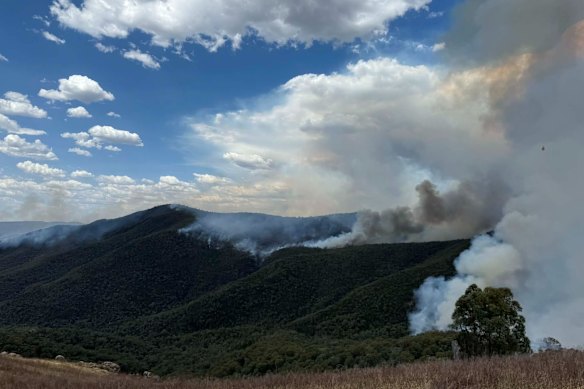
Mount Lawson State Park, where the Walwa bushfire started last week, is now largely burnt.
This year’s fires have burnt diverse ecosystems around Victoria – from Big Desert in the state’s north-west, to cool and damp forests in the Otways and grasslands in central Victoria, and into far-east Gippsland.
Advocates say the dingoes could have been killed by fires that have torn through more than 58,000 hectares in and around Wyperfeld National Park in the Wimmera.
Professor of wildlife ecology and conservation Euan Ritchie said he was not aware of another day in Victoria’s history in which so much of the state – and so many different ecosystems – had been so damaged.
“One of the really important things to bear in mind with these fires is that in some parts of the state, it’s not that long since the Black Saturday and 2019–20 fires,” he said. “So many plants, ecosystems and wildlife populations are probably still recovering, in some ways, from what’s happened in the past.”
Ritchie said Australians generally considered native wildlife and plant species to be resilient to fires, but climate change was exacerbating the ferocity and frequency of bushfires, and weakening native species’ defences to fire.
“Even what we might think of as being resilient species may now not be able to cope because these fires are just coming too frequently, and they’re too large in scale, and they’re too severe, which means that recovery is sort of not possible.”
The Dingo Conservancy secretary Jo Samuel-King said she held grave concerns for the fate of a genetically distinct population of dingoes living in Big Desert, after fires ripped through the dingoes’ known habitat.
“We don’t know if there’s any left,” she said. “We don’t know.” She urged the government to deliver water to the desert park.
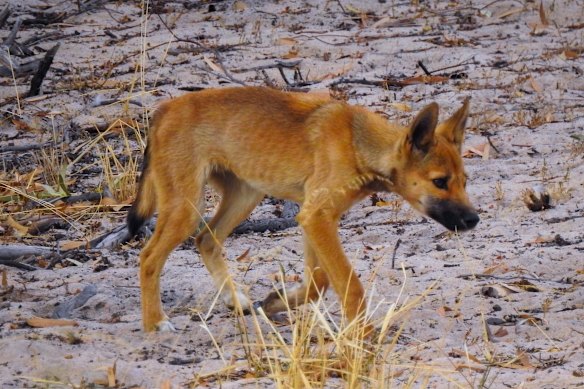
Dingoes in Big Desert are a genetically distinct population. Grave fears are held for their survival.Credit: Ellisha Martion
Ellisha Martion, who has worked for five years to monitor the dingo population, which she estimated to have fewer than 100 adults left last year, said much of the 58,000 hectares of burnt landscape was dingo territory.
“There’s no water in the park, and they’re going to be forced onto private land,” she said.
The Victorian National Parks Association believes the entire Mount Lawson State Park – where the Walwa bushfire began – has been burnt. Mount Lawson is home to critically endangered barking owls, endangered spotted-tailed quolls, and critically endangered Booroolong tree frogs, as well as numerous rare plant species.
Wild Research senior ecologist Glen Johnson said another species of concern were long-footed potoroos, which would now be vulnerable to predator attacks, including by foxes.
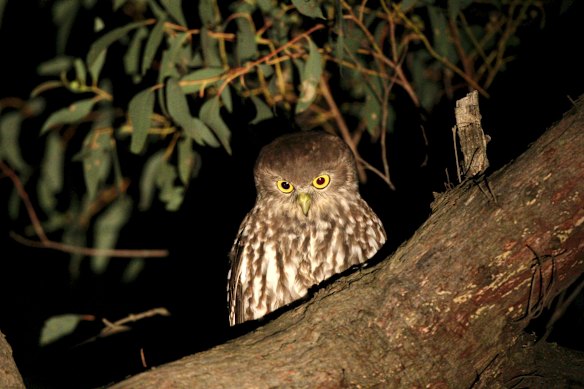
Barking owls are listed as critically endangered in Victoria.Credit: John Woudstra
“The long-footed potoroo is typically in really deep damp forests, which [are] generally not so accessible to foxes. So post-fire [the habitat] becomes much more accessible to foxes, and the impacts on species like potoroos are much more magnified.”
He urged the government to undertake feral animal control programs once the bushfires were out, similar to deer-control programs undertaken in the Grampians National Park following the 2019-20 Black Summer fires.
Loading
In the Alpine National Park, home to vulnerable snow gums and alpine ash, southern sections have burnt, as well as more than half the rugged and remote Wabba Wilderness Park in the foothills of the Great Dividing Range.
Peter Jacobs, a former chief ranger in the Victorian alps turned Upper Ovens Valley Landcare Group president, said alpine ash forests and snow gum forests grew at high elevation in the Victorian Alps.
Alpine ash rely on fire to produce seeds and regenerate. But this can only happen if there is sufficient time between fires, to allow the trees to reach sufficient maturity to produce seeds – about 20 to 25 years.
“What we’re finding, more recent times, is these forests are getting burned multiple times,” Jacobs said. “And if they get burnt under a 20-year interval, it means there’s very little seed to regenerate. And if that keeps happening over multiple times, the forest virtually becomes lost. The whole ecosystem collapses.”
A spokesman for the Department of Energy, Environment and Climate Action said it was deploying staff to respond to wildlife welfare during the current fires.
Loading
“Further wildlife response activities will start as soon as it’s safe to do so for staff and accredited field assessment teams – this will include on-ground teams searching for and assessing affected wildlife.”
Start the day with a summary of the day’s most important and interesting stories, analysis and insights. Sign up for our Morning Edition newsletter.
Most Viewed in National
Loading