3 months ago
17
3 months ago
17
Opinion
November 24, 2025 — 11.58am
November 24, 2025 — 11.58am
Mike Henry had to have another crack at Anglo American, but would have realised that a second tilt at the company was a long shot after its board stonewalled BHP’s three efforts to engage with it last year.
It was an even longer shot this time, with Anglo on the verge of an agreed $US60 billion ($92 billion) nil-premium merger with Canada’s Teck Resources that offers substantial synergies by bringing together the two companies’ significant copper resources.
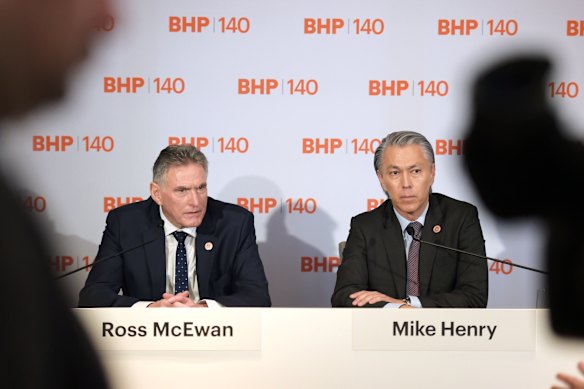
The last throw of the dice by Ross McEwan and Mike Henry failed.Credit: Bloomberg
In fact, it was that imminent merger – shareholders in the companies will vote on December 9 – which created a deadline for Henry and his relatively new chairman, Ross McEwan, to act if they wanted to at least try, again, to get their hands on Anglo’s attractive South American copper interests.
Responding to press reports of its approach to Anglo, BHP said on Monday that it had held preliminary discussions with Anglo’s board, but was no longer considering a combination of the two companies.
Loading
The approach, first reported by Bloomberg, involved BHP, valued by the market at about $205 billion, offering a mix of cash and shares for Anglo, which has a market capitalisation of about $65 billion.
The offer wouldn’t have been as complex as the $74 billion offer BHP made in April last year, which involved demergers of Anglo’s South African platinum and iron ore businesses. The platinum business has since been rebranded as Valterra and spun out by Anglo and trades in London with a market value of about $16.5 billion.
Anglo plans to restart the sale of its metallurgical coal interests early next year. The sale process was stalled by a fire in its Moranbah North mine in Queensland that derailed a $US3.8 billion ($5.9 billion) sale of the mines to Peabody Resources.
It also has started a sale process of its De Beers diamond business, where it has said it has a couple of interested suitors left. It is emerging as a cleaner entity.
A BHP acquisition, had the Anglo board seriously entertained its latest overtures, mightn’t have been as complex or risky as last year’s attempts, but it would still have been expensive.
Since BHP made its three escalating bids last year, none of which gained any traction with the Anglo board, BHP’s share price has fallen about 9 per cent while Anglo’s has risen by a similar amount. The US dollar, BHP’s functional currency, has also depreciated by about 5 per cent against the pound over that period, as has the Australian dollar.
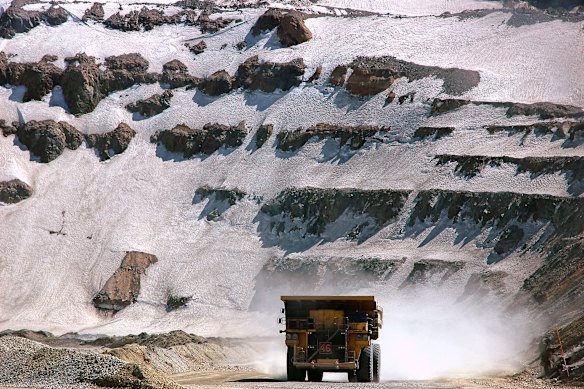
Anglo and Teck have large resources of copper that will, within weeks, probably be out of the reach of the mega resource miners for years, if not forever, if the merger is consummated.Credit: Bloomberg
An offer that simply replicated the same value for the core of Anglo as last year’s would involve significantly more BHP shares or their equivalent value in cash. To get the Anglo board to take it seriously enough to contemplate abandoning the merger with Teck would have required a further significant increase from the value offered last year.
With BHP, which already has the world’s largest copper resources, committed to expanding them, however, it was worth at least making a final attempt to get its hands on Anglo’s copper assets.
If Anglo and Teck shareholders approve their merger, the door is probably shut to any third parties, including BHP.
Loading
The regulatory approvals required would, alone, be a significant obstacle, but it’s the eventual potential for $US800 million a year of synergies from combining their Chilean copper assets – each has a project essentially mining the same orebody – that would be the major deterrent, and inevitably the main reason the Anglo board chose to reject BHP’s approach, which would have given its shareholders a takeover premium, and remain committed to the merger.
The only way back in for BHP in the foreseeable future, it would seem, is if one of the other mining majors – Rio Tinto or Glencore – came to the same conclusion as BHP and made their own move on one of the merging companies before that deal is sealed next month.
Glencore, which has a matching 44 per cent interest with Anglo in the Collahuasi copper project in Chile, has had several tilts at Teck’s copper and coal operations.
It bought a 77 per cent interest in Teck’s metallurgical coal assets late in 2023 after the Canadian company’s founding family, which have super-voting shares, rejected Glencore’s approaches for a full takeover.
Rio, under new chief executive Simon Trott would, like BHP and Glencore, have run the numbers on bids for both of the companies after they announced their merger.
A BHP acquisition, had the Anglo board seriously entertained its latest overtures mightn’t have been as complex or risky as last year’s attempts, but it would still have been expensive.
Everyone wants more copper in a world where demand is exploding – despite recently falling back, the copper price is up nearly 50 per cent this year – as the data centres for artificial intelligence are built and where big new resources are scarce and are expensive and time-consuming to develop.
Both Anglo and Teck have large resources of it that will, within weeks, probably be out of the reach of the mega resource miners for years, if not forever, if the merger is consummated. Any bid by Rio or Glencore for Teck, or Anglo for that matter, would re-open the door for BHP to have yet another go at Anglo.
BHP’s revived interest in Anglo differed from its approach last year, when it tabled three successive (and successively higher) offers in a failed attempt to get the Anglo board to properly engage. This time it made its approach, was rejected, and immediately walked away.
As it would inevitably have been bidding more, albeit with a bid that would be less complex and risky, Henry and McEwan showed discipline in not, again, bidding against themselves.
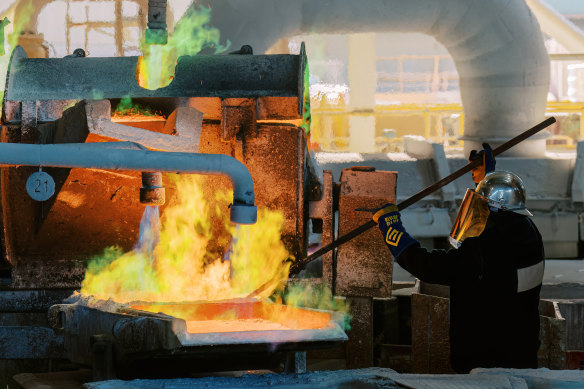
Everyone wants more copper in a world where demand is exploding.
Given BHP’s existing copper portfolio, Anglo was a “very nice to have” set of assets, but not a “must have at any price.”
The willingness to at least test the waters for a bid, however, does signal that a McEwan-chaired BHP is prepared to contemplate a major deal.
Loading
There’s been talk of a tie-up between BHP and Rio’s iron ore businesses, against the backdrop of flatlining or even reducing demand from China and the entrance of the giant Simandou mine in Guinea (in which Rio has a significant interest) to the market and there are other, smaller, copper miners BHP could target to complement its organic growth.
An interesting sidelight to BHP’s attempted bid for Anglo is that Henry, coming up to six years as chief executive, is expected to retire from the role next year.
Would he have stayed on if Anglo’s reception had been warmer, or would it be his successor that would have had to complete the transaction and integrate two large and complex companies?
Unless there’s another last-minute attempt to gatecrash the Anglo and Teck merger, that’s now an academic question.
Most Viewed in Business
Loading