3 months ago
5
3 months ago
5
Be serious, Paul Keating: We need more defence spending, so spare us the cheap shots
Opinion
November 17, 2025 — 3.30pm
November 17, 2025 — 3.30pm
It is not warmongering to discuss how a changing world may affect Australia’s way of life, just as it did during World War II. It is prudent and responsible to have a national conversation about how we prepare for the changes outlined in Australia’s National Defence Strategy. And that preparation must include a clear-eyed discussion about defence spending.
We are repeatedly told by politicians on both sides that Australia faces its most challenging strategic circumstances since the Second World War. They are right. In plain speaking, this means that the potential risk of conflict, or a major military crisis short of it, is rising. And with it, the likelihood that our ADF women and men may once again be called on to put their lives on the line for the nation.
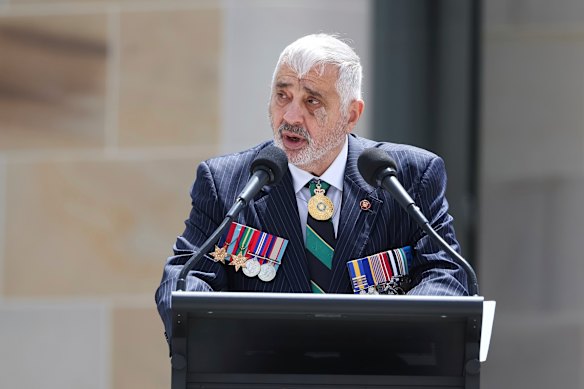
Former RSL president Major General Greg Melick speaks at the Australian War Memorial on Remembrance Day.Credit: Alex Ellinghausen
It is in this context that outgoing RSL president Major General Greg Melick (retired) called on the government to increase defence spending during his Remembrance Day speech.
Former prime minister Paul Keating called Melick a “dope” and accused him of wanting to drag Australia “into a military exchange with the Chinese”. This suggests a deeply unserious grasp of our strategic reality. More troubling, it is disrespectful to our veterans from a man who appears to be better known for his offensive outbursts than his time as prime minister three decades ago.
To reflect on the costs of war and the Australians who have served, without considering whether the next generation may be asked to do the same, is to risk leaving them unprepared. We must ask whether they would have the equipment and resources needed to prevail. Many respected veterans, strategists, former defence ministers and our major ally, the United States, believe they do not.
Loading
Defence spending in Australia now sits at about 2.04 per cent of GDP, meaning just two cents in every dollar of our economy goes towards safeguarding our security in a rapidly changing world. While the government has committed to increasing this to about 2.3-2.4 per cent by 2033-34, this is hardly a historic high. During World War II, defence spending reached about 34 per cent of GDP in 1942-43. Even setting that extraordinary mobilisation aside, in the 1950s it averaged above 3 per cent, and throughout the Cold War it sat at roughly 2.7 per cent. Yet we routinely describe today’s strategic circumstances as more dangerous than those of the Cold War.
Measuring defence spending as a percentage of the economy, the government argues, is unhelpful. While there is some truth to that, it nonetheless reflects where we place our national priorities. If defence is consistently under-resourced, we are not investing in the capabilities our ADF women and men need to succeed should they ever be called upon to defend the country.
At the same time, ministers maintain that it is better to focus on funding the capabilities we need rather than meeting an arbitrary target. While also true in one sense, it is equally clear that the ADF faces significant capability gaps. The reality is stark: Australia now has an extremely limited ability to defend critical infrastructure and ADF bases against missile strikes, a defining feature of modern conflict. While we plan new ships to protect sea lines of communication, the navy is struggling to generate the warships it already has due to sustainment pressures. Our capacity to clear mines from the approaches to our ports, a core task in WWII, is now almost non-existent.
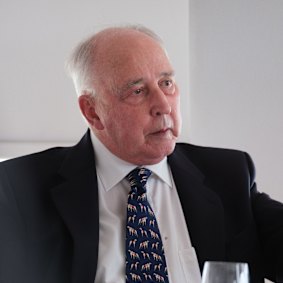
Former prime minister Paul Keating, pictured at an AFR round table in August.Credit: Oscar Colman
I could go on. The list is long. The simple truth is that, on any meaningful metric, our ADF women and men do not have the capabilities they need to protect Australia in a changing world. We need to prioritise our security if we want to preserve the way of life we take for granted.
It is in this context that we should listen to the concerns of our veterans about defence spending and have a serious national conversation about how we support our ADF women and men in uniform as the world deteriorates. What we should not do is personally attack those who raise these issues, as we saw last week.
We are better than that as a country. Our veterans are seeking to protect the nation, just as they did in uniform, through highlighting the risks we face.
Jennifer Parker is a defence and national security expert associate at the ANU’s National Security College and non-resident fellow with the Lowy Institute. She has served for more than 20 years as a warfare officer in the Royal Australian Navy.
Most Viewed in National
Loading