3 months ago
18
3 months ago
18
Guess who said this ...
“I love Bazball, mate. I think it’s brilliant.”
It was August 2023, and Brendon McCullum’s sermoniser barely had his feet under the desk at Tottenham (yes it’s Ange Postecoglou, OK). On June 30, the day before his first day as the first Australian to manage an English Premier League club, Postecoglou had been at Lord’s to take in the second Ashes Test.

Brendon McCullum and Ange Postecoglou. Cut from the same cloth?Credit: Getty
It was the Jonny Bairstow Test before the Bairstow incident. On day three, when England’s wickets were dropping like flies. The celebrated former Celtic manager sat in the Cricket Australia suite with John Howard and Janette and watched Ben Stokes fall to Mitchell Starc for 17 and the subsequent tumble social media jokingly labelled Spursy.
Somebody hoped out loud he would not be taking notes on how to win from the hosts. In Postecoglou’s defence, by the time he was waxing lyrical about Bazball, England had gone on to win two of the last three Tests and drawn the series.
“In any sport, when I see teams kind of break the traditional mould, that’s when people get really uneasy about it – and that’s when you know, ‘OK, this could be something special’“, Postecoglou told Sky Sports just before his Spurs dugout debut against Brentford (a 2-2 away draw to kick off life without Harry Kane).
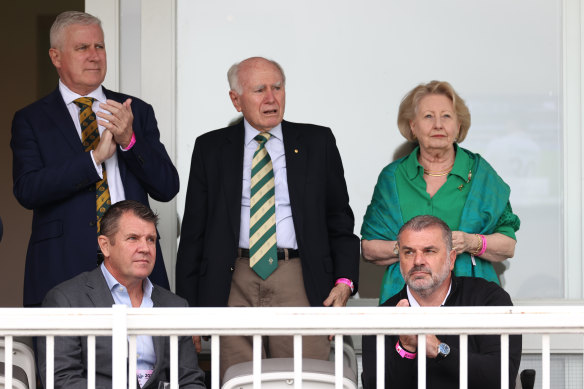
Ange Postecoglou with former prime minister John Howard and wife Janette; and Cricket Australia chair Mike Baird at Lord’s in 2023.Credit: Getty Images
“It’s not guaranteed to work. It could all fall to pieces and end up in tears. But when you make people uneasy and uncomfortable with what they see it probably means you’re breaking new ground, and I love that in anything in life.
“That’s where the special stuff exists, and that’s the kind of space I’m in.”
For both the Australian and New Zealander’s respective sporting revolutions, the two and a half years since has been … eventful. And while it would be presumptive to speak on behalf of the English, some quarters must surely be thinking at this point that Oceania has a lot to answer for.
To quote Postecoglou, there are some uneasy and uncomfortable people after last week’s opening Ashes Test in Perth, though they may argue it is not because new ground is being broken. Not anymore, at least, based on the two-day extravaganza of England profligacy so predictable you couldn’t even argue it was a win for the vibes.
Which is really what got the comparisons going again and has planted one of the more annoying seeds of a question living rent-free in this head (and hopefully nobody else’s): Is Bazball just Angeball with bails? Is Angeball basically Bazball with goalposts?
Is the Stokes-McCullum era about playing a high line against Chelsea with nine men? And if so, would that be brave or a little bit silly? And actually, let’s not answer that second question for fear of dying on such a bold, unconventional hill.
But setting aside feasibility, are there similarities? It is tough to argue there are not, when both share a basic ideology around playing positively without fear of making mistakes, and entertaining in the process. The aim is to win, but you can win even you lose if it looks good. Or you lose “morally”.
Both rescued their respective teams from existential adversity and - for a period of time, at least - reversed their fortunes with a fresh style. Bazball came in swinging with its T20-esque redefinition of tempo to save Test cricket from a boring death. It was vibrant and spontaneous, and a radical break from the orthodoxy. All very un-English. Lots of “cut-through”.
Both styles are also uncompromising, and McCullum and Postecoglou are wedded to them in impressively stubborn fashion. The former has already refused to change the blueprint of the Optus Stadium implosion for next week’s second Test in Brisbane. And while McCullum has, in the past, offered hints of pragmatism, acknowledging the need for “some pretty deep thinking and some adjustment” which then spawned the refined Bazball 2.0, Postecoglou is not friends with pragmatism.
“There’s plenty of room for pragmatism in all walks of life – and in football as well – but I’m just not interested in it,” he said 12 months ago, before winning the Europa League and before being sacked by Spurs and before being appointed and sacked by Nottingham Forest within 39 days.
It hints at a key distinction: the fact that football and cricket are fundamentally different sports. Football is full of philosophies, each with variations specific to any given manager and their squad. Test cricket is Test cricket. It is traditional, and played in the traditional way. To deviate is to flout tradition and disrespect former players, many of whom are now making their opinions known.
The nature of control differs, too. Angeball asserts control through dominance of possession, structured build-up and let’s not get into inverted wing-backs today. Bazball, in relinquishing the traditional Test form, sacrifices defensive batting and attritional bowling for dynamism. Not that McCullum would say this - or even recognise “Bazball”. “I don’t really like that silly term,” he has said. “I don’t have any idea what ‘Bazball’ is. It’s not just all crash and burn.”
‘There’s plenty of room for pragmatism in all walks of life – and in football as well – but I’m just not interested in it.’
Ange PostecoglouWhen in doubt, turn to the Urban Dictionary. The crowdsourced slang (definitely spoof) dictionary, defines Angeball as “a failed football philosophy” and Bazball as “the capacity to lose a wicket in increasingly confounding ways”. The Angeball entry is extreme, but Bazball elicits a chuckle in memory of Saturday’s eight-wicket hiding which did include some genuinely perplexing shot selection.
Pump the ball into the stands even if it doesn’t end up there. Smack it anywhere, really, as long as you are performatively enjoying yourselves. And always attack the bowler, as long as it’s not Scott Boland. This is where the risk-reward ratio is akin to Angeball, and where it’s two men with big ideas want the big thing to work and change the world even when they do not have the personnel at their disposal.
Loading
Of trying to emulate Beethoven without the orchestra to bring the score to life. The ninth symphony was revolutionary because it added an uplifting choir to the final movement. But if Joe Root isn’t delicate enough with the cello and Harry Brook is mindlessly bashing on the timpanis, the Ode To Joy might never arrive.
Most Viewed in Sport
Loading