3 months ago
20
3 months ago
20
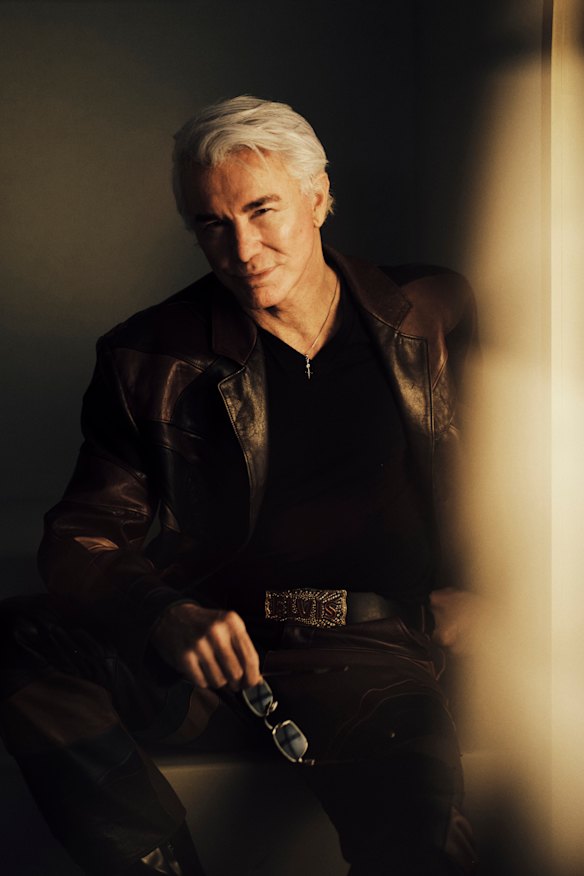
Baz Luhrmann is grappling with the mysteries of Zoom on his mobile phone from an apartment in Tokyo. “You can see I’m a technological genius,” he deadpans, as an offsider in Australia suggests swiping right, then going back to the app, then swiping the other way.
After a few seconds, the Australian director of Strictly Ballroom, Moulin Rouge!, The Great Gatsby and Elvis emerges from the darkness. “Sorry, guys, I was busy landing the lunar module,” he says. “As well as reinventing Einstein’s theory of relativity.”
In high spirits before Christmas, the 63-year-old filmmaker reveals that he is in Japan working quietly on an anime – a Japanese animation – that it is too early to announce officially. That would be a first in an acclaimed career with creative soulmate and wife Catherine Martin that has extended well beyond his six feature films.
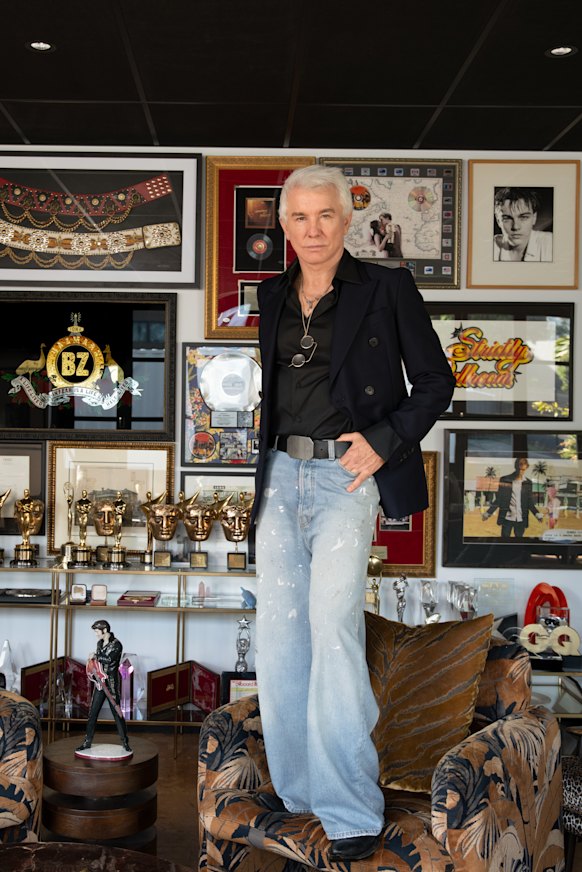
They have worked on operas, a musical, soundtrack albums, music videos and commercials for fashion houses and perfumes that play like short art films, the hip-hop series The Get Down, a Paul Keating election campaign, a theme park and designing hotels and bars, but never an anime.
And that’s not all. Three years since Elvis took Luhrmann to the Academy Awards, where it was up for eight Oscars including best picture, he is preparing to shoot Jehanne d’Arc, about the French national heroine Joan of Arc, on the Gold Coast this year.
British teenager Isla Johnston (The Queen’s Gambit, Invasion) will play Jehanne, a 17-year-old who, possessed by divine voices and visions, saved France in battle before being burned at the stake in the 1400s.
“We’re very proud of what we achieved on Elvis, creating every frame in Australia,” Luhrmann says. “It’s a slightly bigger challenge to create medieval France in the Gold Coast but we have absolutely no doubt we can do it. We’ve even got down to discovering that some of the best medieval jousters and horse riders happen to reside in Brisbane, believe it or not.”
But before Jehanne, another Luhrmann project is heading for cinemas: the documentary-meets-concert film EPiC: Elvis Presley in Concert.
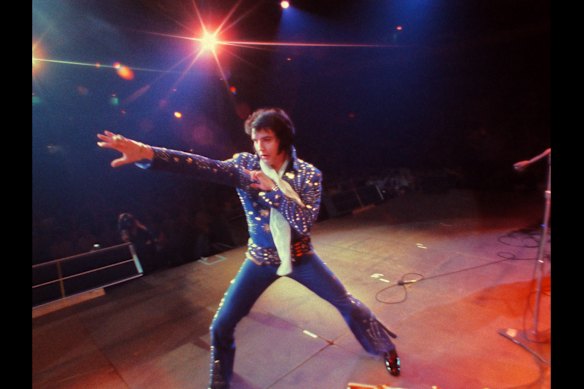
It’s a dazzling whirlwind of a film that uses rediscovered footage from the King of Rock’n’Roll’s Las Vegas performances in 1969 and the early 1970s – some of it found in a Kansas salt mine while making Elvis.
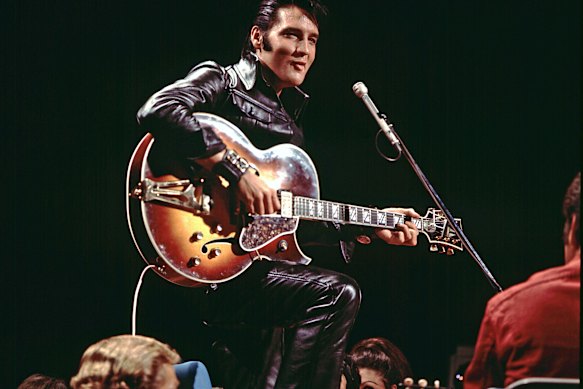
It shows how charismatic he was on stage in his mid-30s, years before drugs and overeating contributed to his death in 1977. You understand why Elvis sold more than a million tickets performing in Vegas over seven years, as well as more than 500 million records around the world.
There are two elements of the new film that flesh out Luhrmann’s earlier portrait.
Behind the scenes in Vegas, Elvis is loose and likeable as he banters with his band and back-up singers away from the frenzied adulation of fans in the outside world. And while everyone knows the hits, it is a revelation how well he covers, with his rich, deep, soulful voice, the likes of Bridge over Troubled Water, You Don’t Have to Say You Love Me and Yesterday.
“He takes the Simon and Garfunkel song and he turns it into a kind of power ballad, a spiritual,” Luhrmann says. “I call him Orphean. Orpheus, the mythical character, was such a great singer that the very rocks and stones would get up and follow him. Elvis could take a song and personalise it in such a way.
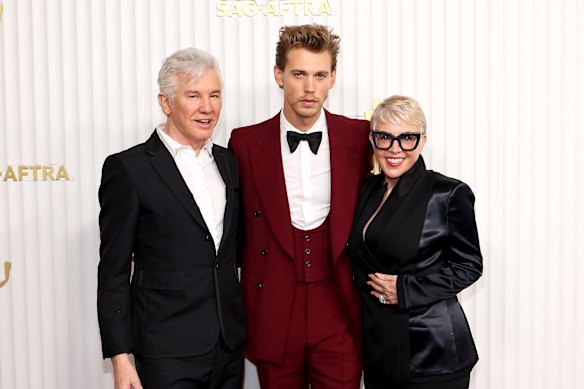
“People don’t understand the level of musicianship that he naturally had. He just looks at musicians and he’s conducting with his body and his soul.”
While researching Elvis, Luhrmann’s team discovered 69 boxes that contained 59 hours of film negative that had lain unseen in the Warner Bros archive in that salt mine. Hollywood studios are among the content creators storing assets in climate-controlled vaults 200 metres underground, away from moisture, the elements and earthquakes.
It was archival material believed lost from two documentaries: Elvis: That’s the Way It Is (1970) and Elvis on Tour (1972).
“They keep them in the salt mines because it’s film, not digital,” Luhrmann says. “If you have moisture, the film melts. The reason no one had gone looking for this treasure trove is that it costs hundreds of thousands of dollars just to open the vaults.
“When I went to make the movie, I had the funds to go looking for the footage on the promise that I might be able to save on visual effects.”
While none of this footage made it into Elvis, Luhrmann and editor Jonathan Redmond wondered how to use it without just reheating previous documentaries. “That’s where we came up with the idea of this being more than a documentary, more than a concert film,” Luhrmann says.
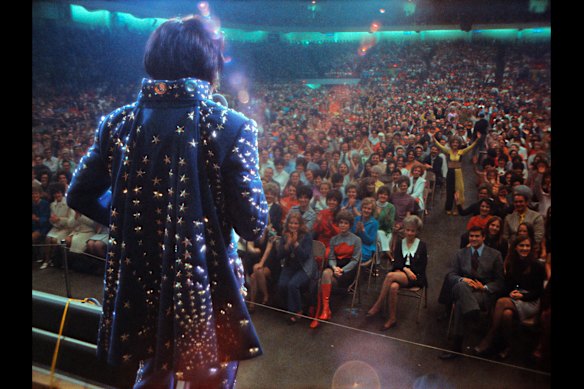
They decided to let Elvis “come to you in a dream”, telling his story in his own voice.
The 96-minute film was warmly received at the Toronto International Film Festival last September. Variety called it extraordinary.
“It’s having an effect even on people who don’t have much of a relationship with or even care about Elvis,” Luhrmann says. “He is someone who’s had many documentaries made about him – and some of them are very good – but they’re generally other people telling you about Elvis. Not actually him telling you in his own voice and in his own words.”
Among the never-before-seen material was 35mm anamorphic footage in good condition, negative with no sound because film and sound were kept separately, and 16mm of Elvis on tour.
Crucially, there was also 40 minutes of forgotten audio of the King talking about his life during filming for Elvis on Tour. One evening he started an interview but it was quickly apparent that he was too tired to continue.
“Elvis was exhausted because it was 15 cities in 15 days and he was doing three shows a day sometimes,” Luhrmann says. “Can you imagine doing that show three times a day?
“Elvis said, ‘Look, guys, I don’t feel physically up to being on camera but I’ll just talk.’ He was able to talk without the camera on, so you hear this very intimate sound. It just seems like he’s speaking to a friend. He’s very unguarded.”
Some unseen Super 8 footage found at Graceland, Elvis’ famous home in Memphis, is also included in EPiC.
It took more than two years for all this footage to be restored by Peter Jackson’s Park Road Post Production in Wellington, New Zealand, and enhanced to cinema quality. Many of the audio tracks did not sync to the footage, so they used lip-reading to match them.
Luhrmann raves about Jackson’s contribution to EPiC. Given the King never performed outside North America, the film is “the world tour Elvis never got to have”.
Jackson made his own terrific documentary crafted from unused and recycled footage, the almost eight-hour-long The Beatles: Get Back (2021) on Disney+, but Luhrmann never considered making a streaming series.
“It’s called EPiC because Elvis, as a performer, was epic,” he says. “It had to be a big-screen experience. It had to be a theatrical experience. It had to be as if you were there.”
So what did he learn about Elvis from all this rediscovered footage?
“I never realised how funny he was,” Luhrmann says. “And you get so clearly that he is so, so, so comfortable on stage but so uncomfortable off stage.
“When you see him on stage, you feel like he’s in your lounge room hanging out. I think this is true of many of the real greats: the love they get when they’re on stage makes them feel still and peaceful. It’s the best version of them.
“Off stage [away from their musical collaborators] they’re nervous and insecure and don’t feel worthy.”
The line begins to break up as, with the interview running long, Luhrmann heads downstairs and then asks for a moment to get into a taxi. He gives the driver a destination then returns to his answer.
“One really well-known person, who I won’t mention, but she’s a legend, said to me, ‘No human is built to be that famous’,” he says. “There’s a level of fame that humanity has trouble dealing with and there’s only a handful of people who have ever been as famous as Elvis.”
That fame was built on more than just his singing voice and stage persona.
“Elvis came up with the idea of turning karate into dance,” Luhrmann says. “At the time … hip hop was also turning martial arts into dance but Elvis created a movement style.
“He also created a visual style [with his] clothing: the Elvis look. He didn’t have a stylist.
“Generally, no one did his make-up; he did his own make-up. It wasn’t like someone came along and said, ‘you should look like this’. He came up with it.”
So how did his fame and impact on popular culture compare with, say, Taylor Swift’s now, as the biggest musical artist around?
“First of all, I have incredible love and respect for Taylor,” Luhrmann says. “I’ve seen her show twice. I do know her. But you can’t make a comparison between her and Elvis.
“There are very few historical figures where you can say a name anywhere in the world and people have some notion of that person. Elvis is one of them.
“I can’t underline how extraordinary it is what Taylor is achieving but the comparison doesn’t really [stand] because of time … Time has to pass before we can talk [about her] in those terms.”
As with every film he makes, Luhrmann has produced a soundtrack. This time it’s a double album of 27 tracks, including restored live performances, studio remixes and medleys.
“We’ve got some amazing new pieces of music that we’ve made up out of Elvis’ music,” he says.
Once both EPiC and the album are released, it will be time for Luhrmann to turn to medieval France, his teenage Jehanne and those world-class jousters and riders. After two films, Elvis will have left the building.
EPiC: Elvis Presley in Concert has an Australian premiere at the AACTA Festival on the Gold Coast on February 7 before opening in cinemas on February 19.
Must-see movies, interviews and all the latest from the world of film delivered to your inbox. Sign up for our Screening Room newsletter.