3 months ago
18
3 months ago
18
First, the apartment developers left western Sydney, lured east by better profits. Now, the banks that lend to the developers could be leaving, too.
Data compiled by KPMG reveals non-bank lenders, mostly private credit firms, are the largest group to finance new apartment builds in Sydney’s western suburbs, financing 45 per cent of the value of the region’s projects. The big four banks finance just 35 per cent, and smaller banks make up just 3 per cent.
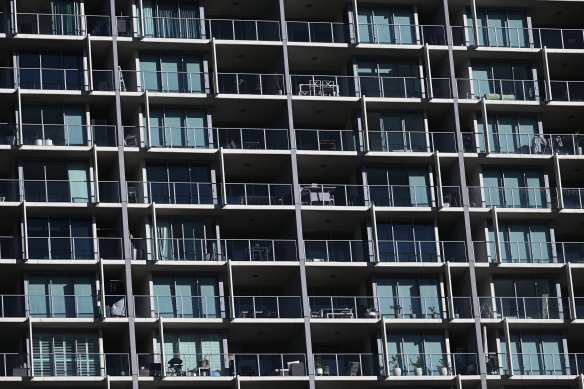
Apartment building development in the western suburbs is increasingly being funded by non-bank lenders.Credit: Dan Peled
The percentage of non-bank lenders is significantly higher than the rest of NSW, which has 11 per cent fewer projects, by value, than the west. The consultancy’s NSW Apartment Development Market Report suggests this means non-bank lenders are “not only financing more projects in Western Sydney, but also larger value projects”.
It reveals how “cheap and cheerful” developments in the west have given way to higher-end luxury developments in more expensive parts of Sydney, and the difficulty developers of smaller apartments have in securing the right funding from banks.
Urban economist Terry Rawnsley said while construction costs remained the same across the city, developers and lenders were making more money in areas with higher property prices, and they were spurred on by the increase in value attainable from rezoned land in transport-oriented development (TOD) areas.
Loading
A third of approvals in NSW in the years before the pandemic were valued at $600,000 to $700,000, he said.
“That was the cheap and cheerful two-bedder apartments in Parramatta or greenfield stuff in Liverpool or the north-west – very accessible,” Rawnsley said.
“Now, the most common product is priced between $1 million and $1.1 million. In that five-year period, you have a $400,000 to $500,000 shift on what the market’s providing. That’s why we don’t have this affordable product at the moment. It’s all more at the luxury end.”
The data was found by analysing publicly available information from local councils about the funding sources of apartment developments that have been approved by councils (not including state significant developments) but that have not yet started development.
Banks are traditionally more rigid in their application processes, requiring larger or more certain gains from loans for developers. Private lenders, on the other hand, are more flexible in their capacity to finance projects.
“What is becoming clear is private credit has a really strong role to play in terms of real estate development in Australia,” said KPMG real estate partner Amanda Coneyworth.
“Some of the limitations banks might have on financing projects are now being filled by the flexibility that non-bank lenders have in terms of being able to finance either higher value projects or projects that might not necessarily have the required loan-to-value ratio, which is really a factor of what the end sale value might be for a project.”
The data included the local government areas of Parramatta, Liverpool, Blacktown, the Hills Shire, Camden, Penrith, Fairfield, Canterbury-Bankstown and Cumberland, but not Campbelltown, which had no apartment developments matching the criteria.
“When major banks say no, that’s when my job comes in to play,” said Zakariah Rahman, executive lending manager at private lending company Maxiron Capital.
“There could be a very, very large range of rejections” from banks, he said. “A lot of the time they don’t say no, but they take a very long time to fund a loan … when the clients need a very quick turnaround on the basis that they’ve got the land on a cheaper price than the actual market value.”
Loading
The city area with the highest number of approved projects yet to start construction was Blacktown, the data showed. Parramatta and Liverpool contained the highest values of projects.
Even though Sydney’s house prices were increasing, Rawnsley said there was reason for optimism: the state government’s “missing middle” housing policy, focused on allowing townhouses and other medium-density homes across much of the city, would increase viability for developers to build in the west.
“Those TODs and planning changes have increased the surface area in Sydney, which means we can get more housing coming in … and with how expensive detached houses are, I suspect more and more of Sydney will be viable for apartment and medium-density living,” Rawnsley said.
The Sydney Morning Herald has opened a bureau in the heart of Parramatta. Email [email protected] with news tips.
Most Viewed in National
Loading