3 months ago
6
3 months ago
6
Opinion
November 24, 2025 — 3.30pm
November 24, 2025 — 3.30pm
The best-laid plans of mice and men sometimes simply get in the way.
Entering the first Test, England looked the better prepared team, bringing an Australia-centric blueprint two years in the devising, and following it to the letter, initially to build a strong position in the contest, then to their ultimate ruin. They could not and did not deviate. They are now back at the drawing board.
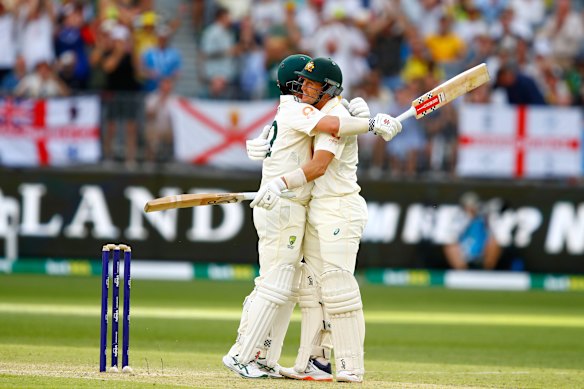
Marnus Labuschagne embraces Travis Head after his epic innings.Credit: AP
Australia’s astounding win was catalysed by an accident. Usman Khawaja’s back injury and its gradual worsening forced Australia to make plans on the run. Who should open the batting had been an open question throughout the prelude anyway, and the uncertainty made it a potential weak spot.
Then Australia had to re-jig in midair, twice. In the first innings, it looked like a case of mismanagement as Khawaja was ineligible to open, Marnus Labuschagne was pressed into service, Jake Weatherald fell second ball and Steve Smith, listed at No.4, faced the third ball of the innings. Australia never really recovered.
For the second innings, they punted on Head, who apparently volunteered. It was as if the captain had asked around for a temp, in the manner of a skipper in a Saturday afternoon park match, so it can hardly be called a masterstroke in concept. Given Head’s my-way-or-the-highway approach – call it Headstrong – it could have gone horribly wrong.
Instead, it became a masterstroke. Head made it one. If you’d gone to the toilet or popped out for smoke or a quick dip while he was in, you might have missed 40 or 50 runs and the Test match making a handbrake turn, such was his onslaught. England quailed before it. In 69 balls, he turned the Test match on its, well, head. No one since Viv Richards has made such devastation look so insouciant.
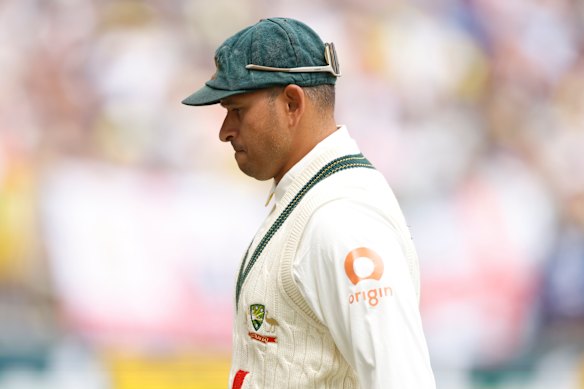
Usman Khawaja was sidelined through injury.Credit: Getty Images
But it’s fair to ask if Head would have played with such abandon if he’d come in at No.5 and Australia were three down for not many. He would have wanted to, but would it have been his brief? At the top of the order, there were still Plan Bs for Australia. At No.5, not so much.
It’s a moot point now. Head played with the sort of licence that Ben Stokes had at Headingley in 2019, and produced an innings no less audacious and perhaps will be seen to be even more consequential.
So it was that desperation led to inspiration, and England’s plans were left scattered and strewn in the gutter, and yet again Australia went 1-0 up in an Ashes series.
Loading
Luck and accident are rarely acknowledged as crucial factors in the unfolding of sport, chiefly because it would disenfranchise an industry of coaches and sundry boffins whose job it is to give the impression that they have everything under control, can foresee every variable and anticipate every twist. Spoiler: they can’t and don’t.
Happenstance happens, sometimes serendipitously, sometimes calamitously. The log is long. Here are some entries. In 2022, an in-form Head contracted COVID-19 before the Sydney Ashes Test, opening up a place for the outcast Khawaja, who promptly made twin centuries and so began a second life in Test cricket that only now is coming to an end – or may already be at one.
In 2019, when Smith was felled by a fiendish Jofra Archer bouncer at Lord’s, Labuschagne became cricket’s first concussion sub, and batted bravely and so launched a fruitful Test career. That day to this year, he and Smith were the fulcrum of Australia’s batting. It cannot have been in either England’s or Australia’s forward planning that Archer would not bowl at Smith again until now (it’s also worth noting that Archer still has not dismissed Smith in Tests).
In 2005, Glenn McGrath trod on a cricket ball on the morning of the Edgbaston Test, turning an ankle and the course of Ashes history. In 1995 in the West Indies, injuries to Craig McDermott and Damien Fleming compelled Australia to attack the home team with a seam combination of Paul Reiffel, Brendon Julian and a then callow McGrath. All-stars they were not, but they dethroned the Windies and founded the Australian epoch.
Loading
When Michael Slater lost his way in 2001, Australia patched in a fringe player to pair with Matthew Hayden at the top of the order. His name was Justin Langer, and so statistically the most successful Australian opening partnership was launched.
The ledger says incident and accident have favoured Australia in Ashes cricket. We’ve always liked to think that it was fortune favouring the brave, though it was at least as much misfortune following the unfortunate. In the prelude to this series, it felt as if all the luck had fallen England’s way for once, right up to the moment Khawaja shambled from the field. It was then that Australia gave a new-old opener his head. If ever there was a player customised to make his own luck and then ride his luck, it is Travis.
Wet blanket alert. For all the exultation about the Perth win, Khawaja is injured and hors de combat, Pat Cummins and Josh Hazlewood are still in rehab and there is some doubt about Hazlewood appearing in the series at all, and Nathan Lyon looks ginger, too. These are the chickens of an ageing team, there for all to see on their perch pre-series and still threatening to come home to roost.
And much as we in Australia might mock Bazball and its motif of self-expression now, it was Bazball – sublimely executed by Head – that won the Test match for Australia. It just wasn’t meant to be that way.
News, results and expert analysis from the weekend of sport are sent every Monday. Sign up for our Sport newsletter.
Most Viewed in Sport
Loading