3 months ago
6
3 months ago
6
Some of Australia’s biggest superannuation funds have been accused of profiting from shipments of Russian oil passing through South-East Asia, raising fears that Australians’ retirement savings are helping fund Vladimir Putin’s war against Ukraine.
An estimated 1 million tonnes of Russian oil have been offloaded over the past two years at a shipping terminal in Malaysia co-owned by a company in the portfolio of an investment vehicle controlled by a consortium of Australian industry super funds.
Russian oil products are allegedly being shipped via a major facility in Malaysia in which Australian super funds have an indirect interest. Credit: Marija Ercegovac
As the war in Ukraine approaches its fifth year with no end in sight, smashing the Russian oil sector’s business model has emerged as a major priority for Western governments seeking to gain the upper hand over Putin.
The Albanese government is investigating ways to close loopholes in sanctions intended to stop Russian oil from entering Australia, but has frustrated the Ukrainian-Australian community by declining to commit to join recent moves by the European Union and United Kingdom to ban imports of oil products refined in third countries from Russian-origin crude oil.
Australian imports from Indian refineries using Russian crude more than doubled between September and October, according to the Centre for Research on Energy and Clean Air (CREA), a Finland-based think tank.
Loading
A group of 16 European Union and Ukrainian civil society organisations this week wrote to Prime Minister Anthony Albanese urging him to close the loophole allowing Russian-origin oil from entering Australia.
“Every litre of this blood oil undermines Australia’s sanctions, strengthens Russia’s war machine, and contradicts support for Ukraine and the rules-based international order,” wrote the groups, including B4Ukraine, an international coalition of civil society organisations focused on ending financial support for Putin’s war effort.
IFM Investors, a Melbourne-headquartered fund owned by 15 Australian industry super funds and one British pension fund, controls 45 per cent of global energy storage company Vitol Tank Terminals International (VTTI). This company, in turn, owns the ATB oil terminal in south-west Johor in Malaysia.
One million tonnes of Russian refined product have been offloaded at the ATB terminal since January 2024, according to an analysis of Kpler trade data by chemical engineer and anti-Russian oil trade campaigner Mark Corrigan. The product is then sent onwards to other destinations.
“VTTI is clearly handling oil products refined in Russia and arriving by tanker from Russian ports at their terminal,” Corrigan wrote in a report sent to the Australian Sanctions Office, which sits within the Department of Foreign Affairs and Trade, last week.
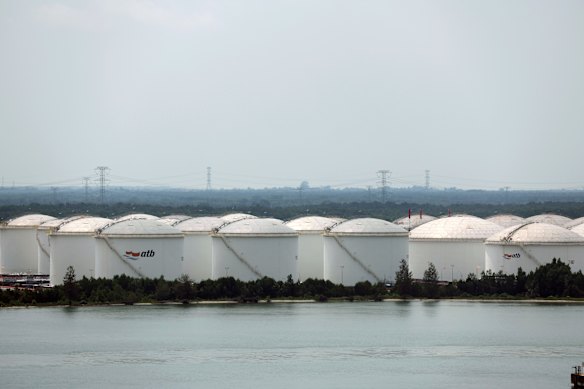
Oil storage silos near the Port of Tanjung Pelepas in Pontian, Johor, Malaysia.Credit: Bloomberg
Kateryna Argyrou, chair of the Australian Federation of Ukrainian Organisations (AFUO), said, “We are extremely troubled that Australian superannuation funds, through investment managers, are profiting from the Russian blood oil trade.
“These superannuation funds, meant to benefit Australian workers, are indirectly supporting Russia’s war by facilitating this trade.
“This raises serious ethical and legal questions, particularly when Australian workers’ retirement savings are being tied to companies profiting from a trade that directly undermines our country’s sanctions and supports Russia’s genocidal aggression in Ukraine.”
She added that the Australian-Ukrainian community is “losing confidence in the Albanese government’s ability to effectively implement sanctions and follow through on their rhetoric of standing with Ukraine”.

Kateryna Argyrou, co-chair of the Australian Federation of Ukrainian Organisations, said the Ukrainian community was losing faith in the government’s ability to implement sanctions.Credit: Alex Ellinghausen
IFM Investors, which manages an estimated $254 billion in assets, is co-owned by AustralianSuper, Australian Retirement Trust, Hesta, UniSuper, Cbus and other industry superannuation funds, as well as a British pension fund.
This masthead asked IFM Investors whether the firm was profiting from the Russian oil trade given its ownership stake in VTTI, and whether it had any ethical concerns about the company’s operations.
An IFM spokesperson said: “We take seriously our responsibility, and that of our funds’ portfolio companies, to act in accordance with the applicable laws and regulations of the countries we invest and operate in.”
Loading
Foreign Minister Penny Wong has urged Australian businesses to ensure their supply chains are not helping to fund the Putin regime.
“Australians do expect that their businesses ensure that their supply chains don’t inadvertently fund Russia’s illegal and immoral invasion of Ukraine. Businesses should uphold that responsibility and expectation,” Wong told Senate estimates hearings in October.
Corrigan, the anti-Russian oil campaigner, said: “Australia’s industry superannuants would be within their rights to be furious that their hard-earned nest eggs are being used to support Russia’s grisly oil trade.
“The umbrella investor, IFM Investors, is abdicating ethical responsibility by allowing tankers of Russian fuel to use their Malaysian asset.”
AustralianSuper and Australian Retirement Trust did not respond to requests for comment.
Karin Op den Kamp, a spokesperson for VTTI, said the energy storage company “does not own, purchase, sell, import, or transport any oil, gas, or refined products”.
“VTTI operates strictly in compliance with all applicable laws and sanctions regimes in the jurisdictions in which it operates and maintains effective measures to ensure compliance and awareness of its sanctions-related obligations,” she said.
Millions of tonnes of Russian oil have also been traded through a Singapore port part-owned by Macquarie Bank, The Guardian reported earlier this month.
CREA estimates that Australia imported $3.8 billion of oil refined from Russian crude between February 2023 and June 2025, generating $2 billion in tax revenue for the Kremlin.
This amount makes Australia the world’s biggest importer of Russian-origin fuel products and easily eclipses the total military and humanitarian aid Australia has supplied to Ukraine since the war began.
Polling conducted this month by Resolve for the AFUO found that 50 per cent of Australians support the government insisting fuel importers do not send Russian oil to Australia, with just 10 per cent opposed and 40 per cent neutral or unsure.
Australian imports from Indian refineries processing Russian crude surged by 140 per cent between September and October, the think tank found in its latest analysis.
Reliance Industries, the owner of the world’s biggest oil refinery and largest Indian oil supplier to Australia, told this masthead this week that it would end the use of Russian oil at its Jamnagar refinery from December, a move that could dramatically reduce imports of Russian-origin oil into Australia.
Corrigan called for the sanctions office to investigate whether any Russian-origin oil products were also making their way to Australia via Malaysia or Singapore, as well as from India.
A DFAT spokesperson said the government had “imposed strict sanctions and other trade measures to restrict the importation, purchase and transport of energy products coming from, or that originated in, Russia”.
“The ban extends to Russian oil shipped via third countries,” the spokesperson said, adding it was currently unable to track the origin of the feedstock used to produce energy products in third countries.
The spokesperson said the government was “evaluating options to place further pressure on Russia’s oil revenues” and “will continue taking action to deny Russia access to Australia’s markets and ensure Australia does not inadvertently fund Russia’s war machine”.
Government sources, who were not authorised to speak publicly, said the government would closely examine the EU and UK mechanisms designed to stop any Russian-origin oil from entering their markets to see whether they would be appropriate for Australia.
Cut through the noise of federal politics with news, views and expert analysis. Subscribers can sign up to our weekly Inside Politics newsletter.
Most Viewed in Politics
Loading