3 months ago
24
3 months ago
24
By Poppy Johnston
December 28, 2025 — 5.35pm
Australia’s destructive ex-tropical cyclone Alfred has been ranked among the world’s most costly disasters fuelled by climate change in 2025.
Economic losses caused by the fierce storm that ravaged south-east Queensland and northern NSW clocked in at roughly $US1.2 billion ($1.8 billion).
The 10 most economically catastrophic events listed by UK-based humanitarian relief charity Christian Aid totalled more than $US120 billion in losses, with each costing more than $US1 billion.
The costliest extreme event influenced by human-driven climate change was the Palisade and Eaton wildfires that ripped through suburban Los Angeles in January.
Economic losses from destroyed properties and other damage caused by the catastrophic blaze surpassed $US60 billion.
Other expensive disasters include cyclones in November that triggered destructive flooding and landslides in Thailand, Indonesia, Sri Lanka, Vietnam and Malaysia.
The tropical storms and extreme monsoon system was thought to cost about $US25 billion, making it the second-most expensive event of 2025.
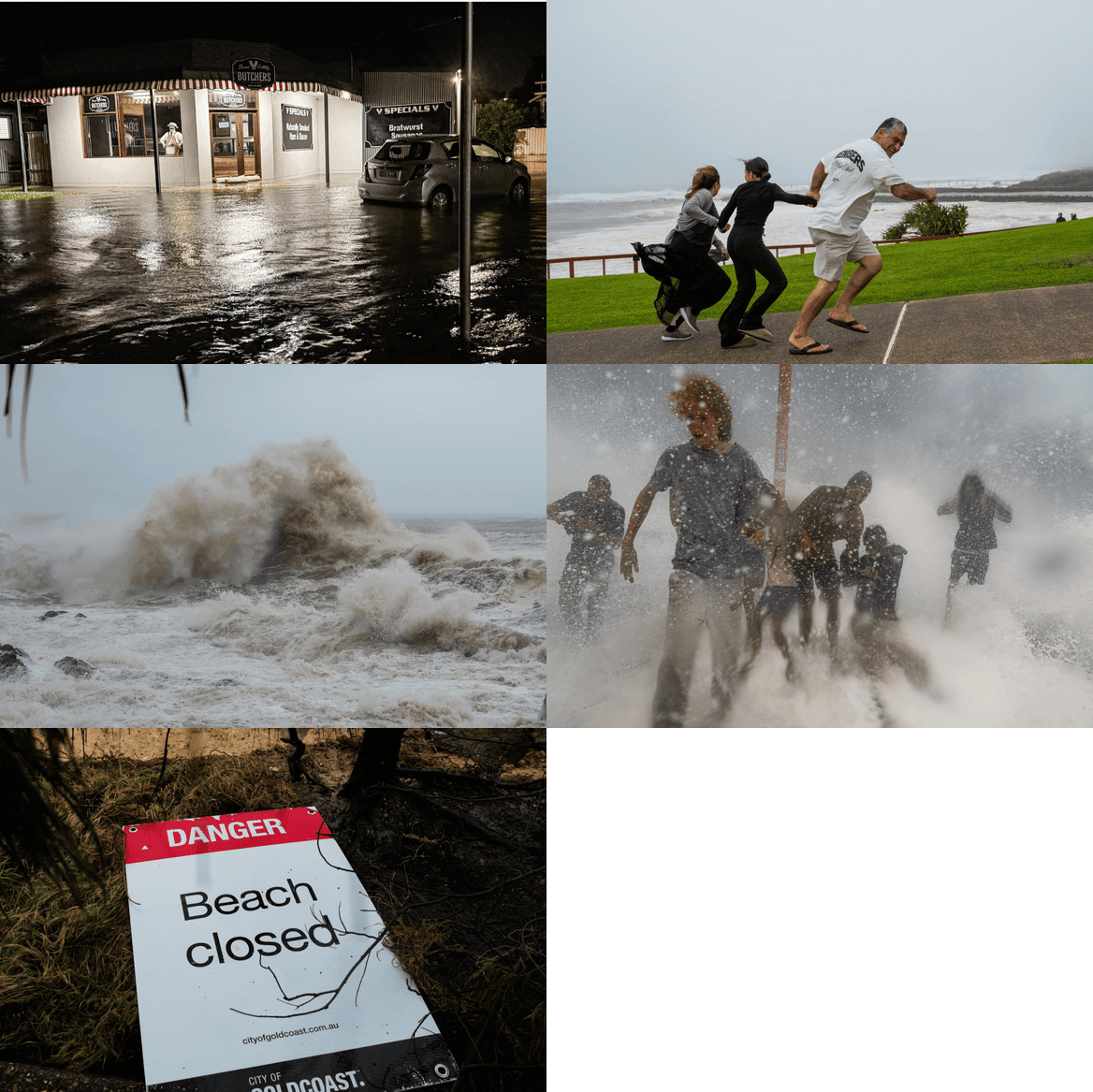
Alfred wreaked havoc on parts of Queensland and NSW in March 2025.Credit: AFR
The flooding disaster also claimed more than 1750 lives, making it among the year’s deadliest climate events.
Extreme rainfall and flooding in China in June and August was the third-most costly event.
Cataloguing extreme weather events is an annual undertaking for the charity seeking to underline the economic and human toll of a changing climate.
It draws on economic loss calculations made by insurance giant Aon, with most estimates based on insured losses and missing the full costs of lost income, environmental degradation and human displacement.

A tin roof hangs on a powerline on in Brisbane amid the cyclone.Credit: Getty Images
The growing body of research linking rising greenhouse gas emissions to specific weather events also informed the report.
Following ex-tropical cyclone Alfred, which was the eighth-most costly disaster listed, ClimaMeter’s “rapid attribution study” found the storm dumped more rain than it would have without human-driven climate change.
Loading
The storm, which threatened to barrel through densely-populated urban centres as a category four tropical cyclone before it was downgraded ahead of landfall, owed much of its intensity and rainfall extremes to above-average ocean temperatures.
Researchers also noted Alfred tracked further south than was normal, sparking concerns warmer ocean temperatures would allow windstorms to veer into new territory and through settlements unprepared for them.
Scientists broadly expect fewer cyclones under a warming climate but the ones that do form are more likely to be more intense.
Davide Faranda, research director at the Laboratoire de Science du Climat et de l’Environnement, said the documented events were not isolated disasters or natural.
“They are the predictable outcome of a warmer atmosphere and hotter oceans, driven by decades of fossil fuel emissions,” he said.

A truck partly submerged due to flash flooding in Brisbane on Sunday.Credit: Getty Images
Wealthy countries tend to place higher on the disaster cost ranking as they typically have higher property prices and residents are better able to afford insurance.
Yet the economies of poorer nations are usually hit harder by climate change extremes as these countries have fewer resources to respond.
Christian Aid chief executive officer Patrick Watt said the findings underlined the urgent need for adaptation, particularly in the Global South where resources are stretched.
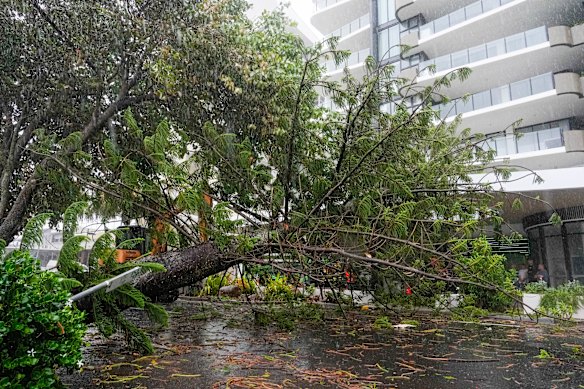
A tree near the shore collapsed facing an apartment complex on March 9 in Scarborough in Redcliffe near Brisbane.Credit: Getty Images
“The poorest communities are first and worst affected,” he said.
AAP
Most Viewed in Environment
Loading