3 months ago
21
3 months ago
21
In these Explainers, journey with us to far-flung regions (and some closer to home) to understand the tensions shaping our world.
See all 38 stories.It started with the merchants in Tehran’s bazaars. Iran’s currency, the rial, slid to an all-time low against the US dollar. Inflation, as ever, was sky-high. Their protests spread across the country. Lockdowns, internet blackouts and crackdowns followed: in two weeks, more than 10,000 people had been detained and several hundred, including students and members of the security forces, were dead. Iran’s leader, Ayatollah Ali Khamenei, warned, “In the face of those who engage in destruction, the Islamic Republic will not back down.”
Meanwhile, US President Donald Trump – whose warplanes bombed nuclear installations in Iran in 2025 – is weighing options for a response, from diplomacy to military strikes.
These are not the first protests against Iran’s ruling theocracy, which has been in power since 1979. In 2022, for example, it was women who led mass demonstrations sparked by the death of student Mahsa Amini after she was detained by Iran’s “morality police” for apparently not wearing the mandatory hijab headscarf. Anger at the ruling regime, as well as the state of the economy, has been simmering for years. How did Iran come to be ruled by ayatollahs? What is its Revolutionary Guard? Who are its avowed enemies and why?
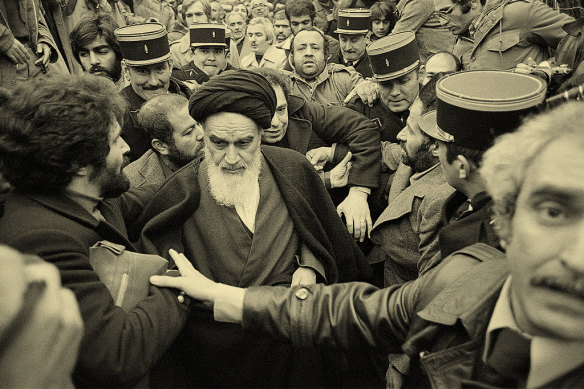
Ayatollah Khomeini in France in January 1979, just ahead of his return to Iran.Credit: Getty Images, digitally altered
What happened in the 1979 revolution?
Iran sits at the crossroads of Asia and the West, once the hub of the Silk Road trading route. “Even before oil, gas and other minerals were discovered in substantial quantities in the 20th century,” writes historian Ali Ansari in his book Iran, “European statesmen were acutely aware of the geopolitical significance of the area.”
Today, Iran borders some of the world’s most volatile regions, including Afghanistan and Iraq, from Pakistan in the east to Turkey in the north. Just across the Persian Gulf are the oil and gas-rich Gulf states; Israel is a day’s drive away (border police and bandits permitting) via Iraq and Jordan.
While Iran, or Persia as it is still sometimes called, is somewhat reduced in prestige since the glory days of its ancient rulers, Iranians like to proudly recall how their nation was a crucible for magnificent cultures that outshone anything in the relatively barbaric West. Take Isfahan, Iran’s one-time capital and with a nuclear enrichment site that made it more recently a target. Built in the 1600s at mind-boggling expense by the Safavid ruler Abbas the First, it was a city of such beauty – intricately tiled mosques, soaring minarets, grand boulevards and water gardens sprinkled with rose petals – that it remains a world-heritage site capable of rivalling Angkor Wat for tourist-pulling power.
Peak ‘shah’ came in 1971, when, to commemorate the 2500th anniversary of the Persian empire, he threw a lavish party in the ancient ruins of Persepolis.
We can trace Iran’s contemporary situation to many flashpoints, but we’ll go to 1953 and the event any Iranian simply calls “the coup”. In a nutshell, amid tensions over neocolonial oil revenue, Britain and the US assisted the military in overthrowing the elected prime minister, Mohammad Mosaddegh, and greatly empowered the Shah, Mohammad Reza Pahlavi.
The shah’s rule, supportive of Western oil interests and US anti-communist ideology, was a mixed bag. For a time, the economy grew, and the nation modernised. But the shah became increasingly despotic, allowing corruption to flourish, brutally suppressing dissent and indulging in extravagances that, by the 1970s, were stirring unrest, especially among left-leaning secularists, more conservative Muslims and those angered by land reforms that had inflamed social tensions.
Peak “shah” came in 1971, when, to commemorate the 2500th anniversary of the Persian empire, he threw a lavish party in the ancient ruins of Persepolis (now also a World Heritage site). Ingredients and staff came from Maxim’s of Paris: truffles, caviar, partridge, foie gras, and 2500 bottles of champagne poured into Baccarat crystals were just the start.
The shah, reported The New York Times, “was in full military uniform, his chest covered with medals. The empress wore a green and white silk ball gown, although it was only 11am, and long white gloves. Some of the emeralds in her 10‐pound [4.5 kilogram] crown were the size of golf balls.” Guests housed in a luxurious tent city included Princess Anne, Princess Grace of Monaco, Ethiopian emperor Haile Selassie, assorted Scandinavian royalty, Richard Nixon’s vice-president Spiro Agnew, and Romanian despot Nicolae Ceausescu. It was quite a gathering.
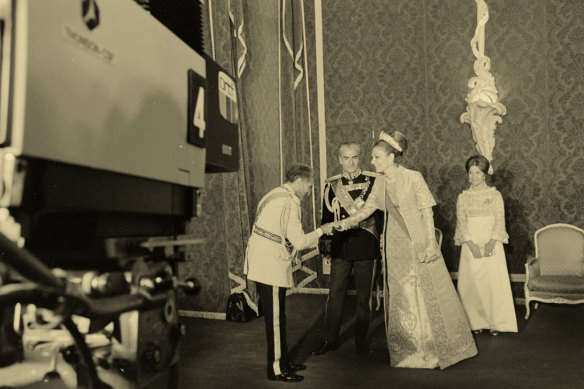
The shah and the empress greet guests to their party in Persepolis in 1971.Credit: Getty Images, digitally tinted
Missing from the party: the religious leader Ruhollah Musavi Khomeini, known as the face of Shia Islam, living in exile after being jailed twice for dissent. But he sent his regards. “Let them go all the way to Mars or beyond the Milky Way; they will still be deprived of true happiness, moral virtue and spiritual advancement and be unable to solve their own social problems.”
By the mid-1970s, unrest was growing within Iran, fuelled by supporters of Khomeini. The economy began to falter. The shah, diagnosed with cancer in 1974, then made a series of fatal missteps, including abolishing the multi-party democracy and arranging a bizarre newspaper article that claimed Khomeini was gay, a drug addict, a British spy and Indian, not Iranian – which backfired by triggering violent protests. Efforts to quash these protests by force only inflamed the situation. By late 1978, the shah’s behaviour was increasingly erratic. A televised flip-flop, in which he promised to listen to protesters’ demands, fell on deaf ears. In January 1979, he fled the country with his family, never to return.
Two weeks later, Khomeini returned to Tehran on a chartered Air France Boeing 747 packed with journalists. “Our culture has been despotism and colonialism,” he declared once he’d made his way through ecstatic crowds, reported the Associated Press. “Everything we had has been thrown to the wind. He, the shah, has made the army follow the orders of another country”, apparently the United States.
Khomeini … quickly began governing with a much harder line than many of his early supporters had expected.
Within weeks, Khomeini had sidelined the provisional government and held a referendum to abolish the monarchy in favour of a type of Islamic government that he himself had devised, based on the concept of “velayat-e faqih”, or “the rule of the jurist”. The referendum passed with 98 per cent of the vote. A new era had begun: that of the ayatollahs.
Khomeini, who had offered the promise of a people-friendly democracy, quickly began governing with a much harder line than many of his early supporters had expected, particularly those on the left, whom he lost little time in purging. He would go on to give Islamic clerics almost complete power over government policy, imprison or execute dissidents, mandate that women wear the hijab headscarf, ban Western music, movies and alcohol, and prohibit men and women from swimming or sunbathing together.
In 2013-14, British adventurer Lois Pryce took her motorcycle to Iran for a 4500-kilometre journey from Tabriz in the north to southern Shiraz. In her book Revolutionary Road, she recounts a visit to a once-bustling beach resort. “It was easy to see how the Caspian coast would have been the grooviest place to be before the revolution,” she writes, “but the last three decades had taken their toll.” She wondered “if I would ever in my lifetime see Iranians returning to these beaches in their bikinis and Speedos”.
Khomeini put in place a new structure of government topped by himself as the supreme leader (and commander-in-chief of the armed forces) with a president below, an Assembly of Experts clerics and a Council of Guardians to decide who could run in parliamentary elections and which legislation should be struck out for not complying with sharia law. Khomeini’s only successor, Ali Khamenei, is 86 but has yet to name a successor. “Khamenei,” wrote Ali Alfoneh for The Arab Gulf States in Washington website in 2023, “presumably wants to have his own preferred candidate succeed him, but he cannot publicly name a successor-designate without creating a rival and bringing about a dual power dynamic undermining his own authority.”
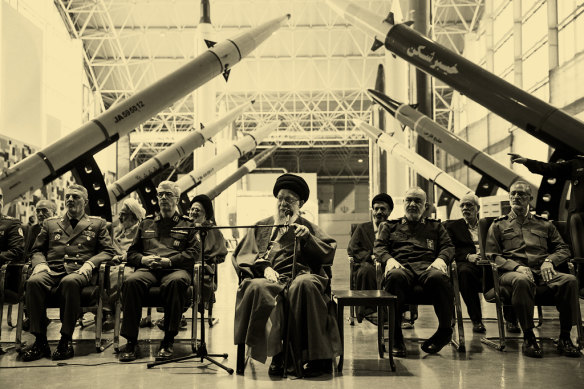
Iran’s Supreme Leader Ali Khamenei visits an exhibition of the Revolutionary Guard’s aerospace achievements in Iran in 2024. Credit: Office of the Iranian Supreme Leader via AP, digitally tinted
What’s the Islamic Revolutionary Guard?
The Islamic Revolutionary Guard Corps is one of the most powerful – and feared – organisations in Iran, according to the Council on Foreign Relations. Separate from the regular military, the Guard is charged with protecting the state’s regime. It is commanded by Iran’s Supreme Leader, Ayatollah Ali Khamenei, and was born of distrust in the regular armed forces among Iran’s clerical leaders after they came to power in 1979, when it was framed as a “people’s army” that would protect the clerics from any coup.
As well as being in charge of law enforcement, the Guard’s interests extend from oil and gas projects to construction and telecommunications. It also runs Iran’s ballistic missile program, which was in the spotlight in June during Operation Midnight Hammer in June 2025 – when US forces followed up an Israeli attack on Iran’s nuclear enrichment sites, dropping bunker-buster bombs on two installations and hammering a third with submarine-launched missiles. Those attacks were in response to Israel’s claims that Iran was days from assembling nuclear bombs.
The head of the Revolutionary Guard, Major General Hossein Salami, was killed in the Israeli strikes and was replaced by Major General Mohammad Pakpour, who joined the guard after the 1979 revolution and fought in the Iran-Iraq war in the ’80s. The Guard’s elite foreign espionage arm, the Quds Force, lost its top commander, Major-General Qassem Soleimani, to a US drone attack in Iraq in 2020.
The Guard is made up of an estimated 190,000 personnel across ground forces, air, navy and cyber forces, and since 2007 has commanded the Basij paramilitary arm, which has about 600,000 members when mobilised, reports the Council on Foreign Relations. (Iran’s regular army has about 350,000 troops, including conscripts.)
Bahrain, Saudi Arabia, Sweden, the United States and Australia (as of November 2025) consider the Guard a terrorist organisation. In Canberra, the move to list it as a state sponsor of terror followed the expulsion of the Iranian ambassador and the closure of Australia’s embassy in Iran’s capital, Tehran, after revelations that the Iranian government had directed at least two attacks against the Jewish community in Australia in 2024.
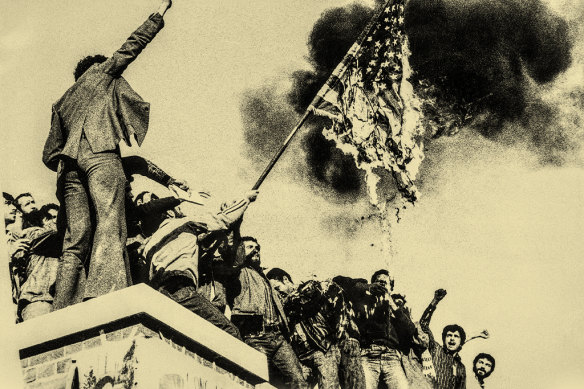
Protesters perched on a wall of the US embassy in Tehran burn an American flag during the hostage crisis of 1979. Credit: Getty Images, digitally tinted
Why does Iran have a problem with the United States?
“For many Iranians and certainly those in the Islamic Republic, the friction can be traced to 1953,” says Ali Ansari, a professor at St Andrews University in Scotland and widely regarded as a world authority on Iran. He means the coup, of course, that Britain and the CIA helped orchestrate.
Then there’s 1979: the US granted asylum to the Shah, prompting angry Islamic revolutionaries stormed the US embassy in Tehran, taking 52 US hostages. They were held for 444 days and released on January 20, 1981, just after Ronald Reagan had been sworn in as president. It was also in 1979 that Khomeini coined his memorable catchphrase: “[America is] the great Satan, the wounded snake.” The shah’s son, former crown price Reza Pahlavi, and other family members still live in the US.
Fast-forward 45 yearsand the great Satan is still enemy number one. Ahead of Iran’s legislative elections in 2024, Ali Khamenei said this: “Elections are a manifestation of the republican system, and this is why the arrogant powers and the US, who are opposed to both republicanism and the Islamic nature of the Islamic Republic, are against the elections and the enthusiastic participation of the people at the ballot boxes.” Who are these “arrogant powers”? Khamenei again, this time from 2023: “The arrogant powers refers to those villainous, aggressive, international forces that always want more and are never ever satisfied with what they have. They observe, make plans, and see that they need to create a conflict in one place in order to profit in some other place.”
Then there are the ongoing US trade embargoes imposed since 1979 and now in a stalemate. In 2018, the US, during Trump’s first presidency, walked away from a 2015 nuclear agreement known as the Joint Comprehensive Plan of Action, designed to limit Iran’s nuclear ambitions. In February 2024, the head of the International Atomic Energy Agency, Rafael Grossi, said Iran was enriching uranium almost at weapons-grade, which belied its claims it was for civilian power production.
“Iran and the United States have many reasons not to trust each other,” says Alem Saleh, lecturer in Iranian Studies at the Australian National University. “But it’s mainly about a power struggle. Iran is located in perhaps one of the most strategically important regions in the world, the Middle East. Therefore, Iran’s rise in power would not only undermine the United States and the Western interests in the region but also would be considered a threat by many of Iran’s neighbouring regimes. So nobody is happy in the region.”
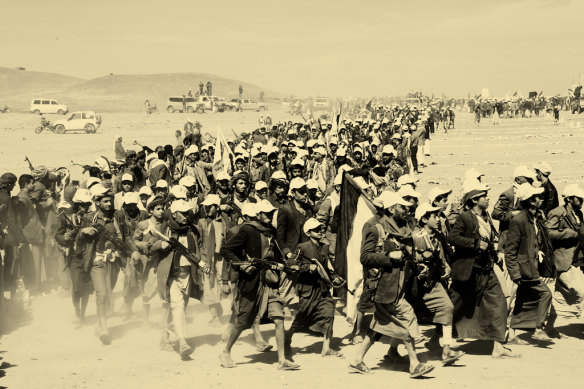
Houthi fighters rally in support of Palestinians in the Gaza Strip and against the US strikes on Yemen in a march outside the capital, Sanaa, in January 2024. Credit: AP, digitally tinted
What’s Iran’s ‘shadow’ war with Israel? What are its ‘proxies’?
For years, Iran and Israel were engaged in a “shadow war”. Israel had long sought to thwart the regime’s ambitions to build nuclear weapons, its secret agents believed to be responsible for assassinating several Iranian nuclear scientists, including one by a remote-controlled machine gun.
In April 2024, Israel seemed to change up a gear when its warplanes destroyed the Iranian consulate in Syria’s capital, Damascus, killing at least 11 people, including two senior commanders in the Revolutionary Guard. It was a provocation that Ali Khamenei vowed would be avenged, foreshadowing the rocket and drone attacks that stepped up the conflict. The attacks caused little damage, in part because Iran telegraphed them.
Then, over 12 days in June 2025, Israel launched strikes against Iran’s nuclear sites, Iran responding with missile and drone attacks against Israel. The US then launched strikes against Iran, prompting Iran to launch missiles at a US military base in Qatar (the base had been evacuated ahead of the strikes). By June 24, a ceasefire had come into effect.
Loading
For many years, Iran had largely limited its threats against Israel to supporting militant and terror groups in the region, notably Hamas in Gaza. It also supports Hezbollah in southern Lebanon, although Hezbollah was significantly weakened by Israeli bombing and ground attacks in 2024. It supports the Houthis, a rebel group that emerged in the 1990s in northern Yemen – and which more recently has harassed military and commercial shipping passing through a pinch point on its way to the Suez Canal in response to the war in Gaza – and various militias and political parties in Bahrain, to whom it provides weapons, financial support and military training through the Guard and the Quds Force. Iran is also “deeply involved” in the affairs of next-door neighbour Iraq, especially since the fall of Saddam Hussein in 2003, according to the Council on Foreign Relations.
It is an unusual arrangement in that the goals of the proxies do not always directly align with those of Iran or its Shia branch of Islam. “Iran is not particularly pious when it comes to which groups they’ll back,” says Ben Scott, a senior adviser at the National Security College at ANU. “They prefer to back groups that are more aligned to them, who are Shia if possible, but they’ll back whoever works. The most prominent non-Shia proxy is definitely Hamas because Hamas is Sunni Arab. It hasn’t been a straightforward relationship, as it has been with Hezbollah [which is Shia].”
‘Plausible deniability is a big part of their approach. All that feeds into the idea of building up this network of partners and proxies through the region.’
Sunni Islam is the largest branch of Islam, followed by most of the world’s Muslims, including those in Saudi Arabia, making it the largest religious denomination in the world. Shia Islam is the second-largest branch of Islam and is the dominant form of the faith in Iran, Iraq and Azerbaijan. (The differences between Sunni and Shia Muslims emerged after a disagreement over the succession to the Prophet Muhammad.)
Loading
Was Iran responsible for the Hamas attacks on Israel on October 7? “We can’t fully attribute Hamas’ attack on Israel to Iran,” Kylie Moore-Gilbert, an Australian-British academic in Middle Eastern political science, told us in 2024. “But I do think that the link there is that after an unprecedented wave of mass protests following the death of Mahsa Amini, Iran’s leaders decided the best form of defence is offence.” Moore-Gilbert was famously detained by the regime for 804 days and now advocates for other hostages and activists within Iran.
“Plausible deniability is a big part of their approach,” says Ben Scott. “All that feeds into the idea of building up this network of partners and proxies through the region, which you can use to carry out these battles elsewhere to attack US, Israeli and Gulf Arab states.”
Iran and the Saudis are on opposing sides in the civil war in Yemen, where the Houthis are pitted against the ousted government supported by Saudi Arabia. Again,” says Scott, “there’s a debate about Iran’s command and control. It’s fair to say it’s much looser when it comes to the Houthis.”
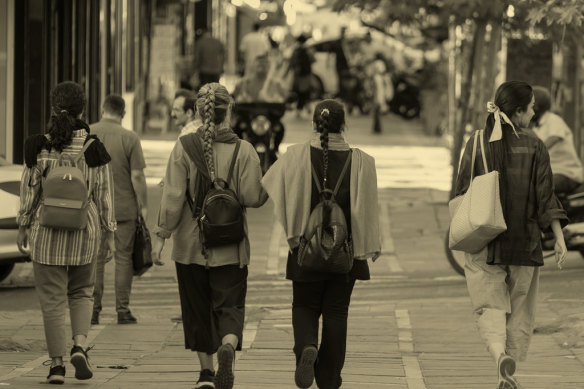
Young women on an avenue in downtown Tehran in September 2023.Credit: Getty Images, digitally tinted
Meanwhile, Iran’s domestic troubles have been brewing for a long time, not least as prices have risen much faster than wages, making everyday items unaffordable. The Financial Times reports that Iran “experienced the world’s fastest growth in the migration rate” to wealthy OECD countries between 2020 and 2021, according to OECD data, an increase of 141 per cent. The number of Iranians studying overseas had risen every year for eight years to 2024, according to the Tehran-based Iran Migration Observatory. Asylum applications rose 44 per cent on the previous year, based on data from the UNHCR.
Loading
Many women continue to defy mandatory hijab rules, in place since 1979, either blatantly or by wearing their headscarves “immodestly”. Since the protests of 2022, newer laws have made wearing “inappropriate” clothing even more criminal, punishable by up to 10 years in jail.
“I don’t think reform has been on the cards for some time,” says Ansari. “The regime has run out of ideas and can only think of doubling down on a fossilised ideology. I think it is on a steady spiral downwards.”
With Maher Mughrabi
This explainer was first published on February 25, 2024. It has since been edited and updated to reflect a series of developments.
Get fascinating insights and explanations on the world’s most perplexing topics. Sign up for our weekly Explainer newsletter.