3 months ago
26
3 months ago
26
Last weekend, I was in Sydney for a 48-hour visit, three weeks after the massacre at Bondi. My son and I went to the beach. Bondi is not merely iconic; it is the site of my childhood summers, a place that once represented ease, openness and belonging.
It was immediately clear that something had shifted.
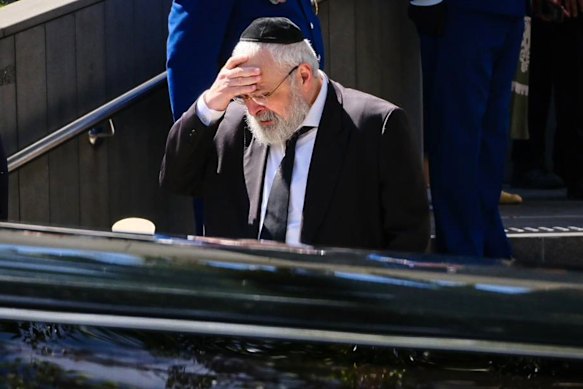
A coffin containing the body of Rabbi Eli Schlanger arrives at the Chabad of Bondi Synagogue during his funeral last month. Credit: Getty Images
The pedestrian bridge from Campbell Parade to the grassy area above the beach – once unremarkable – is now inseparable from footage of the alleged attackers moving deliberately towards crowds of innocent Jewish Australians, gathered to mark the first night of Hanukkah. Bondi, long assumed to be insulated from the world’s darker currents, no longer feels so.
That feeling followed us onto a bus back to our hotel. A lone passenger boarded, clutching a tote bag tightly to his chest, visibly tense. I felt my body react instinctively – scanning, calculating exits, preparing. For a moment, I panicked.
I recognised the sensation immediately.
I spend significant time in Israel. There, vigilance on public transport is not paranoia but a lived reality. Since the Second Intifada – and especially since October 7 – buses, cafes and street corners carry an ambient awareness of risk. Sirens, shelters and security checks are woven into daily life.
What unsettled me was not the fear itself, but where I felt it.
This was Bondi – the adopted home of countless Jewish families after the war, including my own. More than a surf beach, it has long been a civic common: layered with migration, aspiration and trust. And yet, in that moment, the reality of Israeli daily life had followed me home.
That dissonance did not arise spontaneously. It is the downstream effect of a moral climate that has been cultivated, normalised and indulged.
“Israel is a genocidal enterprise.”
“All Zionists are baby killers.”
“Israel is the new Nazis.”
These are no longer fringe slogans. They have become familiar features of protests, campuses and social media since October 7. They are not critiques of policy. They are accusations designed to confer absolute moral guilt – and, in doing so, to dissolve restraint.
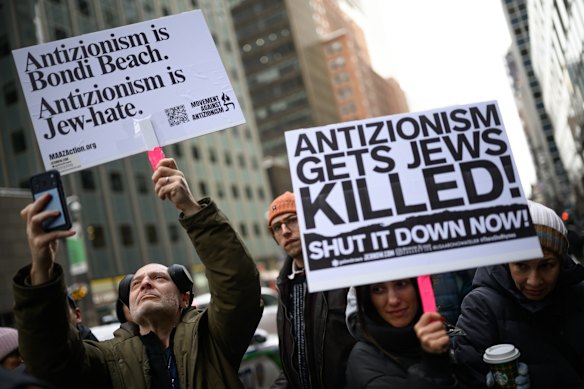
People hold signs at a vigil outside the Australian Consulate in New York City in December.Credit: Getty Images
This is where anti-Zionism must be named honestly.
Anti-Zionism is not simply opposition to a government or a military campaign. It is the latest machination on the antisemitism continuum. Where Jews were once accused as individuals, the accusation is now directed at the collective: the Jewish state.
Anti-Zionism does not have an issue with what Israel does, but its very existence. Israel is cast as uniquely evil, those associated with it are no longer merely neighbours or fellow citizens. For many, they have become proxies. Legitimate targets of rage and scapegoating.
Loading
We have seen this pattern repeatedly. Just last week, Venezuela’s Vice President Delcy Rodríguez claimed a US military operation bore “Zionist undertones”. In moments of crisis, failing regimes reach for a mythic antagonist – one powerful enough to explain humiliation or loss of control. “Zionism” has become that antagonist: shorthand for Western power, coordination and success.
As the weekly protests ostensibly about the war in Gaza continued, the role played by those who triggered the war – Hamas – was erased. Indeed, for some, Hamas’ actions on October 7 and after were defended, glorified and imbued with moral legitimacy.
Chants and rhetoric, including “Globalise the Intifada”, “Death to the IDF” and “There are no good Zionists”, became excused as merely activism.
But as the firebombing of synagogues and vandalism directed at buildings linked to Jews – not Israelis – has shown, what begins as rhetoric does not remain rhetorical.
Bondi proves that Australia is not immune to this phenomenon.
The Bondi gunmen were ISIS supporters, but their plot did not happen in isolation – it grew in this environment. A video they recorded explaining their actions explicitly condemned “Zionists”.
Near the end of this story, it is worth returning to where many Australian Jewish families began. Growing up in a 1970s suburban Melbourne home, we lived under the long shadow of the Shoah. Summer meant the drive north – three children in the back of a Holden – visiting relatives in Bondi.
In those homes lived survivor relatives – I named them the “superhumans”. Polish accents, cosy couches, short-sleeved shirts, dark blue numbers on their forearms. They had witnessed real genocide.
They understood how propaganda prepares the ground before violence arrives. Australia, and Bondi in particular, was their refuge. The Sydney Harbour Bridge, their gateway to safety.
Loading
They also understood something else: that the price of being Jewish has always been to live under the threat of hatred, terror and death in exile, and sometimes even at home.
For many, this reinforced their inextricable connection to Israel – never seen as perfect, but as self-determination. As refusing to remain defenceless.
That price is one Jews have paid throughout history. It was paid on October 7 at the hands of Hamas. And it was paid again in Bondi on December 14.
As I stepped off that bus, one thought stayed with me: safety, like truth, is not self-sustaining. Anti-Zionism is not a harmless posture. It has consequences. And when its language is indulged, the violence that follows should never surprise us.
The urgency now is to confront this reality – to understand how anti-Zionist language and rhetoric were allowed to take hold and become normalised.
The past cannot be fixed, but the threat of Bondi happening again is real, and if it continues to be ignored, it will not stop at Jewish gatherings in public spaces.
Tammy Reznik is a Melbourne-based writer and commentator.
Most Viewed in National
Loading