3 months ago
19
3 months ago
19
Opinion
October 30, 2025 — 5.00am
October 30, 2025 — 5.00am
NIMBYs get a bad rap in Victoria. In Jacinta Allan’s order of villainy, they rank somewhere between the Kennett government and head lice.
As the premier challenges the fast-disappearing notion of one household lording it over an entire quarter-acre block, and presses ahead with her plans to subdivide and conquer middle Melbourne, NIMBYism has morphed into a catch-all pejorative for everything wrong with the suburban status quo.

Credit: Illustration: Simon Letch
It is quite the journey for an acronym which began its life in the late 1970s as a descriptor for people who, not unreasonably, opposed industrial waste being dumped close to their homes.
In announcing a substantial streamlining of the state’s residential planning regime, Allan this week vowed to drag “Victoria’s old-fashioned NIMBY planning laws” into the 21st century and speed up a protracted process which, at its worst, can suck all feelings of happiness from anyone trying to build a house.
The bottom line of the changes – if the proposed laws do what Allan promises – is that building permit applications for a standalone house or subdivision which currently take an average of 140 days to decide must be turned around within 10 days.
This seems an eminently sensible reform which, in a nice change for the premier, was welcomed by the same property industry spokespeople who have spent the past two years as her critics-in-chief.
A more profound shift is what the proposed laws mean, not just for the modern NIMBY, but anyone with Mrs Mangel tendencies towards neighbourhood meddling.
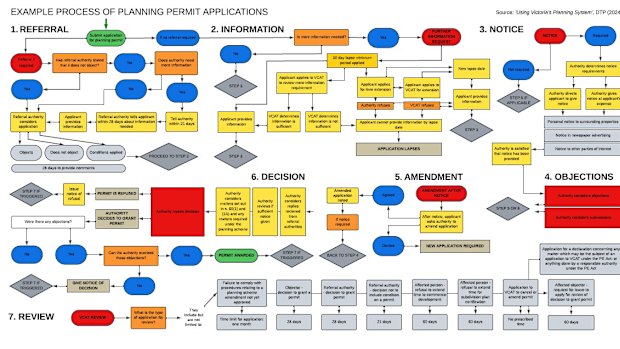
Victoria’s planning approvals process has become a game of Snakes and Ladders.Credit: Victorian government
To illustrate the complexity of the approval process currently in place, someone on the premier’s media team had a lot of fun putting together a Snakes and Ladders-style diagram which, with a bit of imagination, allows you to chart the hapless step-by step progress and regression of a would-be-home builder who takes their freshly drafted plans down to council only to end up, nearly a year later, staring at the white walls of a VCAT hearing room.
At the heart of this ridiculous process is an assumption that people deserve a say over what gets built next door to them, up the road or somewhere in their neighbourhood. Within the 600 pages of the Planning and Environment Act, there is a broad proviso that “any person who may be affected by the grant of a permit may object to the grant of a permit”.
In this age of expanding grievance, our planning laws go out of their way to invite objections by anyone. What could possibly go wrong?
Loading
The new amendments to planning laws scotch this idea by explicitly removing the right for people to object to proposed residential buildings other than large developments such as high-rise apartment towers. You might not like what the neighbours are building next door but as long as it complies with the residential code, they can build what they like on their land – as can you on yours.
I wish this legislation had been in place when we built our house. Back then, our decision to knock down a small, post-war weatherboard and replace it with a double-storey house so infuriated the neighbours on one side, our relationship never recovered from the ill will.
We never landed in VCAT but for 10 years, the paling fence along our shared boundary was as frosty as the Korean DMZ.
The essential gripe of our neighbours, as best I could tell from what they told us between gritted teeth, is that they hated the new house – its size, its shape, everything. And they resented us for building something which, in their words, detracted from their amenity.
There is no question our house affected them, but it was designed and built by an experienced building company and complied with the residential code.
I never understood why our neighbours felt entitled to interrogate every aspect of the construction of our house, as though they were hosting an episode of Grand Designs. They moved a while ago and are no doubt happier for the absence of our presence in their lives.
The revamped approval process does away with the idea that a neighbour or someone living in another street can object to your plans to renovate, bung on a big deck or knock down and rebuild. They simply won’t get a say about what you want to do on your side of the fence.
Loading
Instead, building approval for single dwellings or subdivisions becomes a matter between the person applying for a permit and the local government authority responsible for applying the relevant rules. There is no appeal to VCAT. Local councils will have the final word on whether the proposed designs meet the requirements for border setbacks, window heights and overlooking concerns.
For proposed townhouses and medium-density developments, the process is more involved and can take up to 30 days, but there is still no right of third-party appeal. This is reserved for larger apartment block developments, where approval can take 60 days.
This isn’t merely a better way of handling building permit applications, it is a recipe for improved neighbourhood cohesion. If Robert Frost’s adage about good fences making good neighbours still holds, better planning laws should make for even better neighbours. A state government has taken the path less travelled and actually simplified an area of public law.
As a happy postscript, we now have delightful neighbours on the other side of the DMZ. They are planning to knock down and put up a bigger place. Here’s to a fast approval process and a trouble-free build.
Chip Le Grand is state political editor.
The Opinion newsletter is a weekly wrap of views that will challenge, champion and inform your own. Sign up here.
Most Viewed in Politics
Loading