3 months ago
4
3 months ago
4
If Australia has conceded defeat to Turkey over the hosting rights for next year’s COP climate talks, someone should tell Climate Change and Energy Minister Chris Bowen in Brazil, where he is currently advocating for the bid at this year’s meeting.
Mixed messages from Australia are not making his job any easier, say observers on the ground.
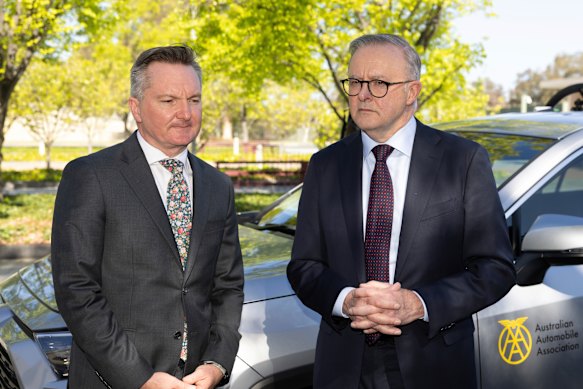
The messages from climate Minister Chris Bowen and Prime Minister Anthony Albanese are mixed. Credit: Alex Ellinghausen
Australia has been making a case to host the talks, along with its Pacific neighbours, since 2022. With the full support of all the other nations in its Western Europe and others UN group, it has long been seen as the inevitable winner.
All other nations in the grouping, that is, except for Turkey, which is prosecuting its own campaign to host COP31.
The impasse must be broken before the current talks in Brazil end at the end of the week. If it is not sorted, UN rules dictate that the conference reverts to the headquarters of its climate bureaucracy in Bonn, Germany. German officials say they back Australia’s bid, and they would prefer not to be lumped with the task of organising one of the world’s largest diplomatic events at the last minute.
Loading
Either way, Australia and Turkey are digging in. Or it looked like they both were until Prime Minister Anthony Albanese said during a press conference on Tuesday evening that if Turkey was the eventual winner, Australia would not block it from hosting the talks and force them back to Germany.
Rather, he would press for a meeting of world leaders associated with the big conference to be held in the Pacific.
This position contradicts the reassurances Bowen has been giving his Pacific peers for months that Australia would fight to the end to host the talks.
He was making that case in Belem, Brazil, just hours before Albanese’s press conference south of Perth. Bowen appeared alongside his peers from Vanuatu and Tuvalu, Ralph Regenvanu and Maina Talia, to press the case for an Australia Pacific COP held in Australia.
“Let me make it clear, we’re not going anywhere,” he said. “It’s the fight we’ve got to have because it is very much in Australia’s interests, and I believe in the world’s interest, having Australia as the president of COP31. That’s what we’re working on. That’s what we intend to do.”
Then came Albanese’s intercession, and a corrective released by the prime minister’s office hours later.
“Australia has been clear it respects the multilateral system,” it began.
“If Turkey were chosen, we wouldn’t block their bid. But Turkey has not been chosen. Australia has the overwhelming support of our peers.
“Turkey shouldn’t block us, just as we wouldn’t block them if the situation were reversed. But of course we will continue to negotiate with Turkey in good faith for an outcome in the best interests in the Pacific and our national interest.”
Loading
Dr Wesley Morgan, a Pacific specialist at the Institute for Climate Risk & Response at UNSW, notes that an Australian failure to host COP would come at a diplomatic cost beyond simple embarrassment.
As the federal government seeks to build its ties across the Pacific in the face of China’s rise in the region, our neighbours have (barely) tolerated the expansion of Australia’s coal and gas export industry.
The payoff has been that Australia would focus the world’s attention on the region and the existential threat it faces at a COP hosted here.
“The Pacific would be disappointed if Australia is not going all out at the crunch time,” Morgan said.
Whether the gap between Bowen and the PM’s rhetoric is one of emphasis or fact, the mixed messaging is alarming observers in Brazil and the Pacific.
It has weakened Australia’s case as it approaches the last hurdle. It has led to speculation in Canberra that Albanese’s ambition on climate might be lower than Bowen’s, just as his stance on the environment was seen as softer than that of the previous environment minister, Tanya Plibersek.
At the time of writing, it is late night Tuesday in Belem, Albanese and Bowen only have until Friday, Brazil time, to sort this out.
Cut through the noise of federal politics with news, views and expert analysis. Subscribers can sign up to our weekly Inside Politics newsletter.
Most Viewed in Politics
Loading