3 months ago
30
3 months ago
30
By Richard Jinman
December 23, 2025 — 4.00pm
In March 2020, a day before the UK’s first COVID lockdown, an envelope was pushed through the letterbox at Nicholas Hytner’s North London home. It contained the outline for a play or film – the author was unsure which – set in the fictional Yorkshire town of Ramsden in 1916. The 50 hand-typed pages described how the town’s choral society was having to recruit teenage boys for a performance of Elgar’s The Dream of Gerontius because most of its older men were fighting on the Western Front.
The manuscript came with a cover note addressed to Hytner, a director probably best-known in the UK for his transformational 12-year stint as the head of London’s National Theatre. “Scrappier than usual though at least it’s typed, though by me so it’s probably in parts incomprehensible,” wrote the playwright Alan Bennett. “I’m also not sure if manuscripts can be infectious.”
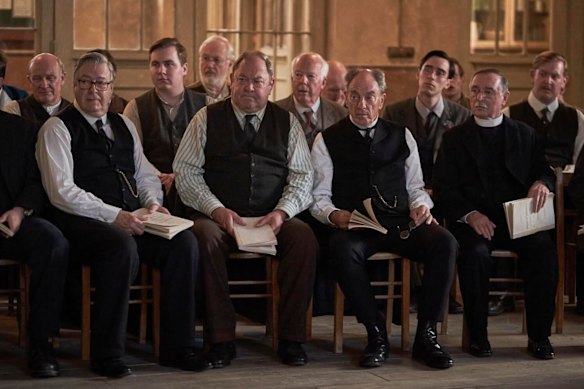
Roger Allam (left foreground), Mark Addy, and Alun Armstrong in The Choral.Credit: AP
Hytner has directed three successful films based on Bennett plays: The Madness of King George, The History Boys and The Lady in the Van. Indeed, he has described his working relationship with the 91-year-old English writer as “the great constant of my creative life”. As a result, he knew a second-hand envelope shoved through the letterbox was simply Bennett’s preferred way of sharing new work.
“Alan’s getting older, so I suspect his partner, Rupert, delivered it,” explains Hytner, 69, when we meet at a hotel in central London. “He’s never bothered with a laptop; he still writes everything on a manual typewriter. When he has diaries to publish, Dinah Wood, his editor at Faber, will be down on the floor in his front room sorting through stuff he’s written and stuffed in drawers.”
Over time, the contents of the envelope evolved into The Choral, Hytner’s fourth big-screen collaboration with the playwright, screenwriter, author and actor. The film stars Ralph Fiennes as Henry Guthrie, a brilliant musician recruited to knock Ramsden’s amateur singers into shape. Guthrie, who is gay, an atheist and a Germanophile who likes to quote Goethe in public, is a controversial appointment, to say the least.
Loading
Hytner, who first directed Fiennes in a 1991 production of King Lear, says the actor was always keen to play the choirmaster. “The part sang to him and he really liked the idea of being involved in something that Alan had written,” he says. In the wake of his Oscar-nominated role in the papal drama Conclave, Fiennes’ presence also lends The Choral some serious star power, although Hytner seems equivocal when I mention it. “If you work as one of Ralph’s colleagues in British theatre he’s just one of us,” he says. “He’s the most direct, dedicated person you’ll ever meet. He just happens to have this parallel existence as a movie star.”
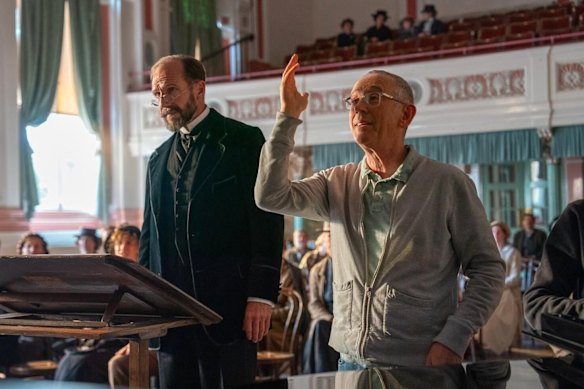
Ralph Fiennes (left) and Nicholas Hytner on the set of The Choral.Credit: AP
At first glance, The Choral might be mistaken for one of those rather manipulative period dramas about the north of England; the kind where stoic men and women overcome hardship through the transcendent power of art. Hytner points out that Bennett, who was born in Leeds in 1934, would never fall prey to such tropes. “Alan isn’t sentimental, he’s melancholy,” he says. “He acknowledges that human relations are fraught with difficulties and as we get older people start to retreat into their own personal enclave. So there was never much risk of sentimentality.”
Although it is never shown directly, the war casts a long shadow over The Choral. Mill owner Bernard Duxbury (played by Roger Allam) has lost his son to the fighting and his wife is consumed by grief. Mark Addy, another British TV stalwart, plays a photographer who snaps portraits of newly conscripted young men unaware of the horrors awaiting them.
In one of the film’s most heart-wrenching scenes, Guthrie, whose clandestine lover is a seaman on a German battleship, is forced to listen to the choir’s jubilant rendition of Land of Hope and Glory when they learn that the enemy vessel has been sunk in the Battle of Jutland with the loss of 839 lives. Devastated, but forced to conceal his feelings, Guthrie later exclaims, “F---ing war. The vicars want it. The women want it. The idiots getting killed, they want it. Who do you turn to?”
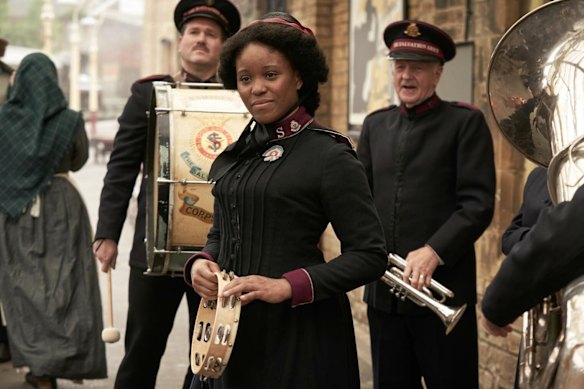
Amara Okereke as Mary, whose expressive voice becomes integral to the choir.Credit: AP
Hytner believes the film provides an answer to Guthrie’s anguished question: one turns to art. “The film doesn’t have a message, it’s not that kind of film, but the people in the choir find that making music together gives them some meaning as individuals and as a community. I found that very moving.”
Music is essential to Hytner, who has directed many operas and dance works. “Listening to music and making music [he sang in choirs at school in Manchester] have been absolutely central parts of my life,” he says. “If the clock was ticking for me, it would be music that I would turn to even before theatre, to be honest.”
He concedes it is difficult to imagine a group of contemporary teenagers being electrified by Elgar’s oratorio about the journey of a pious man’s soul to Purgatory. “There’s no point being nostalgic or reactionary about this,” he says. “You can’t recreate the conditions of 1916 when people were members of church choirs and if you didn’t learn piano you had no music.”
Loading
He also agrees that “high art, through no fault of its own, has been removed from the spectrum of possibility for so many kids”. But he argues that the young people in The Choral experience the same feelings as the members of a community choir or a hip-hop group on a TV talent show. They know the power of music; its ability to connect people and articulate inchoate feelings.
When it previewed at The Toronto International Film Festival in September, the film was described as having “a History Boys kind of energy”. Hytner, who directed the stage and film versions of Bennett’s story about a group of grammar school boys and Hector, their eccentric teacher, acknowledges the parallels. The History Boys was a showcase for a group of little-known young actors, some of whom (James Corden, Dominic Cooper and Samuel Barnett, for example) went on to have major careers. The Choral is also stacked with fresh, largely unfamiliar faces. They include Oliver Briscombe, a Yorkshire native whose performance as the naive 17-year-old postman Lofty is his first professional role. Lofty’s cocky best friend Ellis is played by Taylor Uttley, whose main claim to fame is a recurring role on the British radio soap The Archers.
In a pivotal scene, Lofty bemoans the fact he has never been in love, tasted champagne or seen the sea. Ellis reminds his friend about a visit to the seaside town of Morecambe. “Aye,” says Lofty sadly. “But the sea wasn’t in that day”.
Says Hytner, “I find it incredibly moving that a writer [Bennett] who is now in his early 90s is still sympathetic and super insightful about the primal urges that young people have. With the clock ticking on their lives they [the young members of the Ramsden choir] want to connect, they want to have sex, and there’s something joyful and life-enhancing about that.”
I ask Hytner if he ever worries he might have received his last envelope from Bennett. After all, the playwright has said he’s surprised to have made it into his 10th decade after a battle with colon cancer in 1997. “The important thing is that he doesn’t,” replies Hytner. “As far as he’s concerned there’s a whole pile of used envelopes left to fill. There’s going to be a big surprise next year. It won’t involve me, but it will show categorically that he’s still at it.”
The Choral is in cinemas from January 1.
Find out the next TV, streaming series and movies to add to your must-sees. Get The Watchlist delivered every Thursday.
Most Viewed in Culture
Loading