Stacy Librandi was new to disaster relief when she arrived in Haiti in 2010. She walked onto the Port-au-Prince airfield and looked out at the sea of people in front of her. It looked like its own city: a crowd of a thousand buzzing and sweltering in the Caribbean heat, living in tents and haphazardly stacking mass amounts of supplies—food, water, clothing, medical aid—along the tarmac.
It was late January, and the catastrophe of the magnitude 7 earthquake was unfolding in Haiti. Librandi, part of the latest planeload of like-minded volunteers, was young, untrained and eager to make a difference in the face of devastation.
She brought only herself and some camping supplies in a small backpack with plans to stay no longer than a week. She stayed two weeks and then three—and now, 16 years later, Librandi remains in Port-au-Prince building and running HERO, or the Humanitarian Emergency Response Organization, the largest and foremost emergency medical ambulance and medevac service in Haiti.
"I never saw my life going this way," she told 60 Minutes. "I just came down thinking I am going to give this a complete shot. And that was when I was born in a lot of ways."
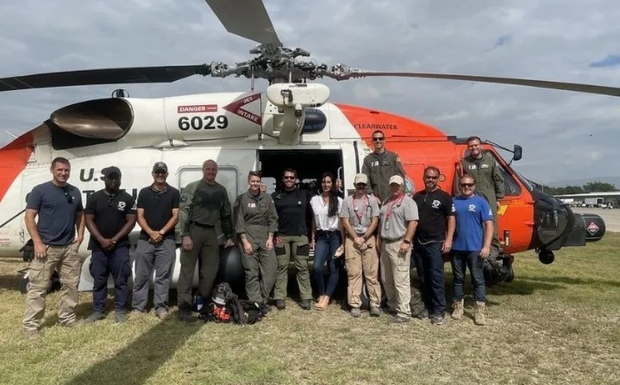 Librandi and her team standing with the U.S. Coast Guard. The Coast Guard thanked HERO for providing "vital support" in the rescue efforts following the earthquake in August 2021, which struck the southern claw of Haiti.
Photo from HERO
Librandi and her team standing with the U.S. Coast Guard. The Coast Guard thanked HERO for providing "vital support" in the rescue efforts following the earthquake in August 2021, which struck the southern claw of Haiti.
Photo from HERO
Librandi before HERO
Stacy Librandi was born in San Diego, CA and put up for adoption as a baby. She had an "unconventional" childhood, she said, quitting school somewhere "between 7th and 9th grade" to live as a "nomad," hopping freight trains and crisscrossing the country.
She married at 19 and settled near her husband's family in the Bronx neighborhood of New York. They had three kids. Librandi — his last name, which she kept after divorcing — spent almost 10 years in the city, trying to build a life, a family and a photography business. Then, in the winter of 2009, after a building fire wrecked her apartment, she was living out of her car and took stock of her life. She had, at that point, a failed marriage, a never-ending schedule of bartending shifts, and an imploding photography business, damaged further by her losses in the apartment fire.
Disaster struck in Haiti on Jan. 12, 2010 and within weeks, Librandi was on a plane to try and help.
"It was a kind of kneejerk decision," she told 60 Minutes. "But I had a feeling, and I didn't have anything to lose."
She left for Haiti and HERO grew in response to the need in front of her, which she says started on the airfield in 2010. Librandi remembers food sitting on the tarmac "literally rotting in the sun." So, she started facilitating. She found a handful of people, including an English to Creole translator, filled a box truck with aid and distributed it at a nearby camp of people. Then she had the translator explain to the camp that they would be back the next day with more supplies, and when they did, the people needed to line up specifically.
"People said it was a bad idea to go out like this, that we were going to get mobbed," she said. "But we went back the next day and the men and women and children did exactly what we needed."
Librandi's process caught on pretty immediately and she saw some of her methods replicated on the airfield.
"I have a unique way of problem solving," she said. "And the ideas I had just seemed to work."
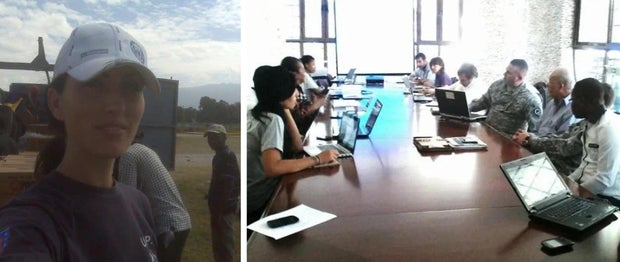 Left to right: Librandi at the Port-au-Prince airport in 2010 in front of the box truck her and her team filled with aid; Librandi and the HERO team meeting with the U.S military and disaster relief officials in Haiti around 2016.
Photos from Stacy Librandi
Left to right: Librandi at the Port-au-Prince airport in 2010 in front of the box truck her and her team filled with aid; Librandi and the HERO team meeting with the U.S military and disaster relief officials in Haiti around 2016.
Photos from Stacy Librandi
Continuing to help in Haiti
Librandi's company HERO, which 60 Minutes paid to escort our news team to Port-au-Prince, offers the preeminent first response in Haiti. It's "the highest level of pre-hospital care in the entire region of the Caribbean," according to their website. It serves all 10 Haitian states, providing a 24/7 response to anyone who calls, functioning as Haitian 911, the first and only local operation of its kind.
In the years following the earthquake, outside of a trip to see her kids who lived with their father in New York, Librandi stayed in Haiti consulting and organizing ambulance services, trying to pair international assistance with the needs in the country. She lived with her translator's family in their one room home under a tin roof, she told 60 Minutes, and rode around on a motorcycle meeting with various groups facilitating aid and clean up.
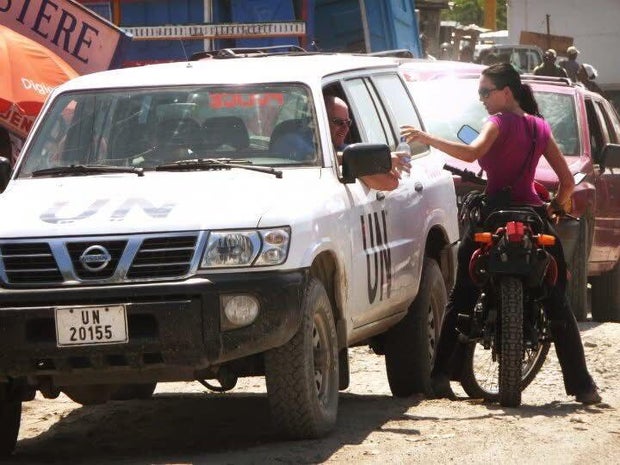 Librandi on her motorcycle in Haiti.
Photo from Stacy Librandi
Librandi on her motorcycle in Haiti.
Photo from Stacy Librandi
"I had nothing at the time," she said. "There were ladies that gave me coffee and bread with peanut butter on credit because I didn't even have 50 cents."
She lived on that credit and her own sense of purpose and found kinship in her Haitians colleagues. Eventually, Librandi was invited to meet with the United Nations World Food Program, the lead agency for supplying food in Haiti, and then meeting invitations kept coming.
"It was that time that I had a lightbulb," she said. "I wanted to see what would happen if ambulances worked in Haiti."
Librandi started to brainstorm. The biggest hurdle was funding; she didn't have any. She came upon a feasible model: a 911 membership program, where people pay an annual fee, "low cost, because it's for everyone," and in return, the company provides ambulance and EMT services for a year.
Haitians were skeptical; reliable emergency services were a foreign concept. But the team pressed on. They started taking EMT courses run by international charities, and they were provided a base, which was a house where Librandi lived and ran dispatch.
"And then, we just inserted ourselves. Our guys were showing up on motorcycles and helping people," she said.
Most who received care at that time were not paying members. Librandi expected this; the business model would need to adapt to the demand, she just wasn't sure how yet.
Then, with the donation of HERO's first ambulance in 2012, they branched out exponentially. The team bought uniforms and Librandi started making deals with insurance companies, regional ports, local manufacturers, and tourism boards to provide emergency response for their staff. HERO's business model, she soon discovered, worked. It scaled. The contracts with the large entities allowed them to operate freely in responding to any emergency—those of members, who could afford the $100 USD annual fee, and nonmembers.
"HERO thrives in filling the gaps," said Coralie Caze, HERO's general manager and Librandi's business partner.
Caze, who was born and raised in Port-au-Prince, joined HERO in 2018 and stresses the importance of the company's dexterity.
"It doesn't matter what comes up, we are out in the street responding, which is exactly the kind of operation needed in Haiti," she told 60 Minutes.
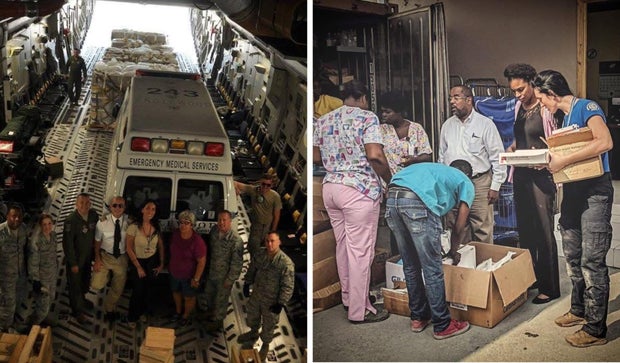 Left to right: HERO's first ambulance was donated in 2012, flown in from the U.S.; Librandi and a team organize aid for Haiti.
Photos from Stacy Librandi.
Left to right: HERO's first ambulance was donated in 2012, flown in from the U.S.; Librandi and a team organize aid for Haiti.
Photos from Stacy Librandi.
Adapting to gang-controlled Haiti
The company's most dramatic reform came in 2021, when Jovenel Moïse, Haiti's then president, was assassinated and armed gangs began to take over Port-au-Prince. The little infrastructure propping the country up crumbled. Criminal gangs blocked airports, boat ports and roads, cutting off much of the country's access to food and supplies; they overtook police stations, and began killing, raping and burning neighborhoods.
Librandi and her team were determined to meet the burgeoning needs of Haiti. One of the first calls they received was from the office of the deceased president: the first lady was injured and needed to be evacuated. Librandi took a breath, made some calls and coordinated her medevac to the U.S.
Then the airport shut down. Then all the roads. Locals, tourists and international volunteers were left stranded in their posts all over Haiti. Librandi facilitated a helicopter and evacuated them, and now HERO operates four helicopters used routinely as medevacs and air shuttles.
And Haiti's plunge into insecurity has all but dried up its pool of volunteers.
"This was the land of NGOs, the land of Missions, and all those jobs are just gone now," Librandi said.
HERO remains one of the only operational crisis relief groups because almost 95 percent of the staff is Haitian; a factor imperative to the company's success, said Caze.
To combat the intensifying danger of their work, HERO recently added a security wing, HALO Solutions Firm, under the management of Librandi and Caze, and operated by former U.S. military, armed, and abetted by a fleet of bulletproof vehicles. HALO began as a means to protect their EMTs and now offers the preeminent security consulting services in the country.
Today, HERO contracts with the U.S. Embassy, the U.S. State Department and the Haitian National Police Force to provide security and emergency services (from first response to physical and emotional rehabilitation) within Haiti. They have 10 ambulances and around 120 employees: EMTs, medical staff, full-time emergency managers, surgeons, neurosurgeons, orthopedic surgeons, Search and Rescue, a dentist (Caze), and communication and geospatial experts. They work closely with local hospitals, and will soon have their own Level II Trauma Center, set to be operational by the spring. In the last months, the company has taken several meetings with South American and African nations looking for HERO to replicate its services abroad.
In: