3 months ago
4
3 months ago
4
There are two stories Judith Nangala Crispin tells about her solo journeys criss-crossing the central Australian deserts on a motorcycle with her mongrel dingo Moon on the back. One is a blog that aims to empower women. It covers just one of the 37 crossings she made, and it’s full of adventure and drama.
Right from the start, her Suzuki DR650 bike had tyre trouble, and she was stranded for two days in the middle of nowhere. She battled through a desert heatwave, floods, hundreds of kilometres of potholes, corrugations and ruts. Worst of all, Moon was bitten by a snake, and she drove for seven hours through the lightning-streaked night to a vet in Katherine, convinced that Moon would die on the way. Luckily, he survived and they both got safely to the end of the journey at Canberra.
The second story about her desert odyssey enters an entirely different visionary world of star maps, spider threads and UFOs in the sky, the spirits of dead animals ascending and a quest to find a caravan of dog-headed beings with bodies made of stars. These are some of the astonishing phenomena explored in Crispin’s illustrated verse novel, The Dingo’s Noctuary (a noctuary is a night diary).
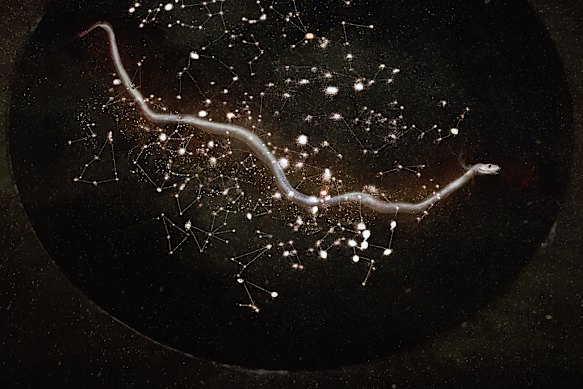
“Zoe descends to comfort her daughters, in a burning country”.Credit: Judith Nangala Crispin
Crispin’s motorcycle odyssey came to a sad end during her 37th journey. She was driving through Broken Hill when “I was run over by a mum shouting at her kids in a gigantic SUV”. She was left with a traumatic brain injury and damage to 126 muscles down her spine. “The book was only half finished, but I had this terrible sensitivity to light from the computer, it gave me blinding headaches.”
So she wrote the second half of The Dingo’s Noctuary on a 1966 Olympia Splendid 33 travel typewriter. “It transported me back to when I was 15 and thought I was going to grow up to be Gertrude Stein.”
This is the third book from the acclaimed poet. It’s a big handsome hardback that took more than seven years to complete, and it’s already won or been shortlisted for poetry, art and photography awards even before publication. The poetry alternates with prose, hand-drawn maps, plant pressings and 47 Lumachrome glass prints of dead animals and birds.
“The book is about what I found,” Crispin says. “As a person with mixed heritage and Aboriginal ancestry but without any cultural authority, acceptance or ties, what relationship could I have directly with country that’s not just a platitude? It took 37 trips to feel I knew enough about country and people and myself to write anything meaningful.”
Crispin is a descendant of Bpangerang people from the Murray River, and she also acknowledges heritage from Scotland, Ireland, France, Mali, Senegal and the Ivory Coast. She spent more than 20 years searching for her grandmother’s history, hoping it would make her feel she was “a legitimate Aboriginal person”.
But it was a rough search. “I’d known we had Aboriginal ancestry since I was a child. We were all told this is something you never talk about, my grandmother and mother were very emphatic,” she says. “Terrible things would happen to the family if you said anything … There is very little on the white record for some people because the families try so hard to cover it up. I was feeling increasingly illegitimate, I didn’t belong to white culture or Black culture, and I thought, do I keep going on?”
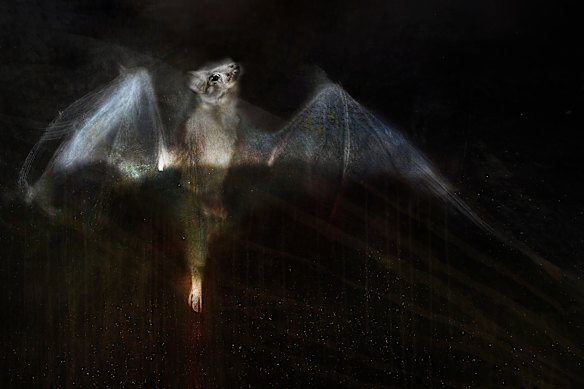
One of Crispin’s Lumachrome glass prints, “Enid, connected to Earth by zodiacal light - spider-strings in the old language, the umbilicus of Country.” Credit: Judith Nangala Crispin
Along the way she met many “despairing” people on the same quest. “I wanted this book to be for them. You can walk out on the land and form your own relationship. You don’t have to walk through life feeling like half a person because you don’t have your heritage papers in order.”
By the time she discovered her link to the Bpangerang people, she had already spent 15 years living with the Warlpiri people in the Northern Territory. She worked for PAW, the remote Indigenous media organisation, mentoring, working with an app for suicide prevention and with the painters: “It was the painters who were trying to free me from dogma.” The Warlpiri are her adopted people and she took their skin name Nangala as a sign of respect.
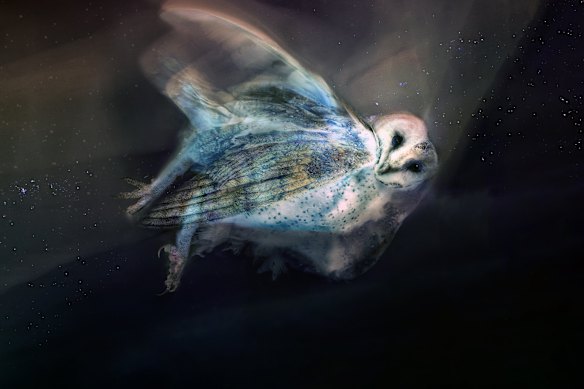
‘One clear night, Lilian followed the Milky Way out toward Orion. All her life she had stared up at Betelgeuse, the giant red star, and felt it staring back’: Crispin’s Lumachrome Glass Print and chemigram of roadkill Australian Masked Owl.Credit: Judith Nangala Crispin
Beloved Warlpiri friends and mentors appear often in The Dingo’s Noctuary, and she has given them their own voices. One of them is Lily, “one of the most miraculous people I’ve ever met”. She lived in a humpy until she was 98, and at over 100 she was taken to a nursing home with dementia.
The first time Crispin visited her there, Lily had decided she was a new mum to an Aboriginal baby doll and a couple of toys. She was having trouble breastfeeding them, so Crispin got her a bottle. Lily told her many stories: one was about a mountain, and if you went past it, you would find dog-headed people with bodies made of stars. Crispin honoured her stories and made them a feature of her journey: “I told Moon those stories when I was driving him to the vet, trying not to be a complete nervous wreck.”
She knew she wanted to talk about the land and people as they were, without romanticising, “but I didn’t want the book to have this weight of suffering and poverty and hopelessness. It’s about the love that people out in the desert have for that place, and the love I had, which came through being able to see what they saw.”
The Warlpiri women taught her that a woman can stand up strong after birth, and at death too, grief-stricken but not shattered. “So I thought I’d try and honour the dead, starting small with animals and plants and work my way up.”
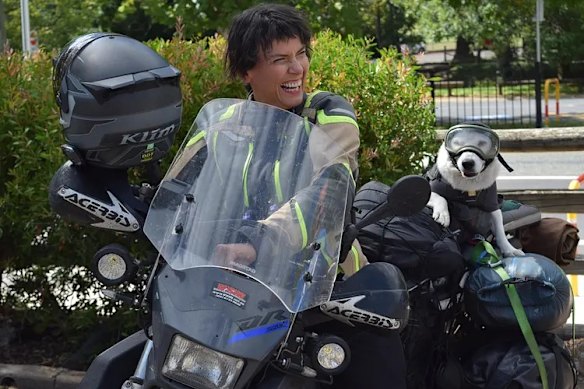
Crispin and Moon on their motorbike.Credit: Judith Nangala Crispin
The first roadkill she collected for her portraits was a tiger snake. The process of decay gave out a light that exposed the image on the page. The images can be put in an art gallery and honoured the way we honour saints in a church, she says. “I portrayed them as ascending back to their ancestors in the sky. I sat with more than 500 cadavers as they bloated up and broke down and then buried them. There’s a smell, but you can ignore it. And the rest feels kind of holy.”
T
Four years later, Crispin and Moon live on unceded Ngunnawal/Ngambri Country near Braidwood on the NSW Southern Tablelands.
Loading
She hasn’t ridden a motorbike since the accident, is still struggling to get behind a car wheel and describes herself as “a crumbling mess of osteoarthritis”. But she’s sustained by the things we don’t know.
“We have this Newtonian rationalism where there’s nothing beyond the material,” she says. “But none of that stuff has a base in sense and lived experience. Sometimes we forget we live in the middle of a great mystery.”
The Dingo’s Noctuary (Puncher & Wattmann) is out now. All profits go to the training programs in Lajamanu by The Purple House, and the expansion of their remote dialysis unit.
The Booklist is a weekly newsletter for book lovers from Jason Steger. Get it delivered every Friday.