
 3 months ago
72
3 months ago
72
When Cyclone Narelle tore through the state’s far north earlier this year it caused devastation to the coastline and the local wildlife.
But there was something else, hidden beneath the waves, that had scientists concerned.
They had been working on restoring the local coral reefs in a WA-first trial, after a severe and prolonged heatwave caused a mass bleaching event at a “scale and intensity … never before been witnessed in WA waters”.
The Nyinggulu Coral Larval Enhancement trial, managed by the WA Marine Science Institution as part of the state’s $11 million Reef Regen Program, was pulled together in just two months.
Scientists headed out on the water to collect millions of coral eggs and embryos during two separate spawning events – one in Exmouth and the other in Coral Bay.
The Exmouth spawning was impacted by strong winds, but the team was able to collect spawn from individual corals at sites like the Mesa reef.
Around 800,000 healthy coral larvae were raised in specialised holding tanks, with over 3000 baby corals settling onto concrete tiles placed in the water.
Those tiles were then put back into the ocean along the Mesa reef, with the remaining larvae released directly onto the reef.
It was then that Cyclone Narelle hit, at the end of March.
WA Marine Science Institution chief-executive Luke Twomey said the cyclone passed directly over the reef and scientists had feared the worst.
But after inspecting the site following the storm, the tiles were miraculously still in place and the coral was still growing.
“It was a huge relief,” Twomey said. “It takes years and years for coral to grow, and we feared we had worked so hard to give them a kick-start, only for that effort to fall short.”
He said the warm water that had tracked down the coast from the tropics had been “really deep and really wide” and persisted for several weeks, which was why the heatwave had caused such significant damage and required effort from scientists to help get the reef regain life.
The widespread death and signs of stress had brought scientists to tears the first time they saw it, according to Twomey.
At the Tantabiddi Boat Ramp, one of the worst affected spots, 80 per cent of corals died. Twomey said the bleaching was patchy, with some spots fairing better than others.
He saw the devastation first-hand back in December.
“I have three teenage boys who jumped in to snorkel and came back up saying, ‘There’s nothing here to see’,” he said.
“I got in and couldn’t believe how different things were – it was depressing, and it really broke my heart.”
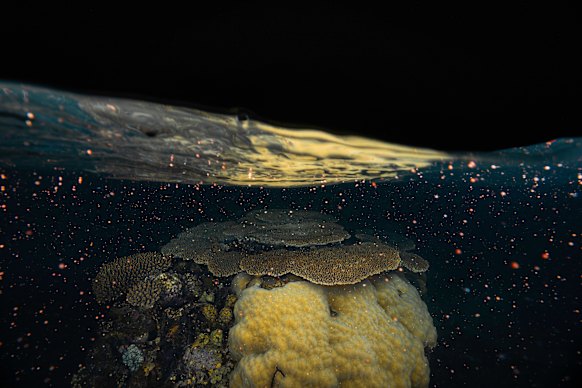
After Cyclone Narelle, Twomey’s team re-focused their attention on Coral Bay where bleaching and cyclone impacts were lower, this time managing to collect more than 100 million eggs and embryos – a much more successful effort.
That resulted in more than 70 million competent larvae, which were deployed to settle across multiple reefs in Coral Bay.
Nyinggulu Project Director Jenny Shaw said the success of the project remained to be seen.
“We’ve been able to give the spawning process a hand along, and despite the weather at Exmouth, we’re really pleased with how things went,” she said.
“The trial has enabled us to collect new data about the reef in locations that were previously unrecorded.
“This is the kind of innovative interventions required to accelerate coral regeneration processes for WA and Australia to combat the impacts of climate change and marine heatwaves on our beautiful and valuable coral reefs.”
Twomey said the next step was to look at methods of helping the reefs survive during any future marine heatwaves.
“One thing we are looking at is if it is viable to transport more heat-resistant corals down to the Exmouth region to insure those reefs can sustain life in the event of a heatwave,” he said.
“We are also look at what is effectively a sunscreen for corals.
“It’s a tricky business and we will be grappling to find new and innovative solutions until climate change is properly addressed.”
Start the day with a summary of the day’s most important and interesting stories, analysis and insights. Sign up for our Morning Edition newsletter.

















































