3 months ago
52
3 months ago
52
As it happens, I don’t arrive on horseback for my interview with Judith Neilson – the trailblazing philanthropist, businesswoman and art collector – but it is nice to know that I could have if I’d wanted to.
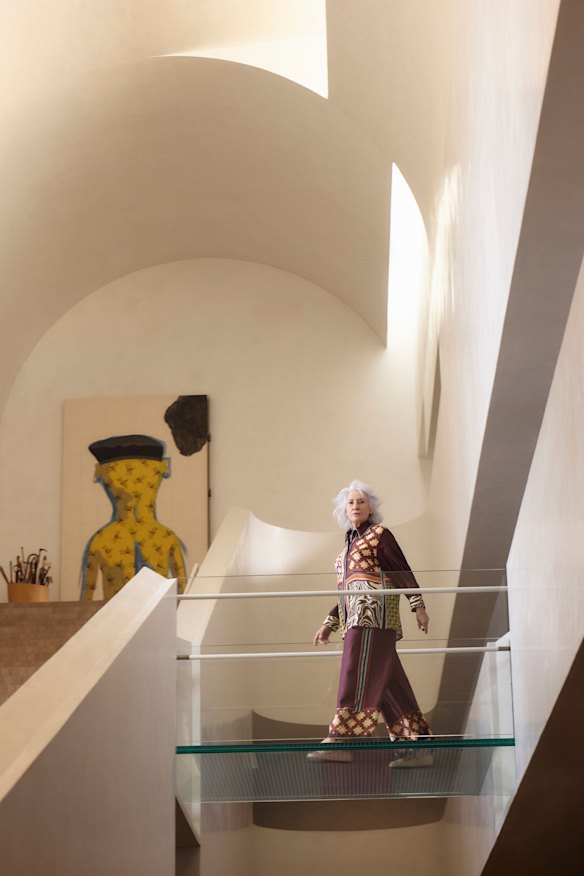
The astonishing atrium of Indigo Slam, her residence in Sydney’s Chippendale, has a huge, sweeping staircase, which she famously had built to mimic the gentle gradient of a European château. “I wanted a staircase wide enough for a horse to walk up,” she tells me. “I thought if a pope came to visit, he could get lifted up the stairs on a horse.”
I’m not a pope, but I’m welcomed anyway, ushered by Neilson’s executive assistant through the entrance hall, past the 60-seater dining hall on the ground floor with its piano for live performances, and up the light-filled stairwell.
We hear Neilson calling from somewhere in the upper reaches of the home, before she pops her head over the first floor gallery wall, then appears at the top of the stairs, in front of a single abstract canvas. She’s clad in a blue-and-green striped cotton maxi-dress and chic platform sandals, with her silver-grey hair loose around her shoulders. She wears no jewellery.
We settle in the main living and dining space, which dominates the first floor. It’s full of art and collectibles, including two large, arresting paintings of bare-chested Chinese policemen, a chess set with African animals as the carved wooden pieces, a coffee table laden with vintage silverware, a wooden statue of a standing woman, a large silver platter of coloured tribal bangles, and a row of three colourful beaded masks from Mexico. Another platter on a sideboard holds vintage silver lighter cases; yet another houses ornate silver and gold fountain pens.
Neilson’s home is not exactly what you would call a house. It is a grand residence, commissioned in 2015 and built over four years by architect William Smart.
Neilson had worked with Smart on the White Rabbit gallery space, which showcases her incredible collection of contemporary Chinese art, a few streets away. Following her divorce from her husband Kerr in 2015, she wanted somewhere to live that was new and would be all hers.
“I don’t like renovators’ dreams,” she tells me. “I think it is a terrible waste because the work just doesn’t last. So I wanted to build a house that would last 100 years, and be very specific. You can’t change anything in this house.”
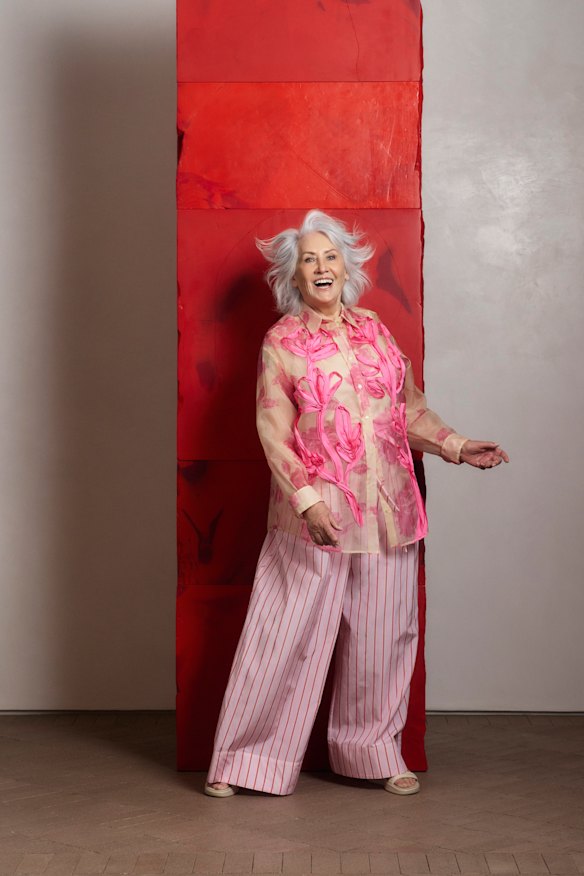
The home will become part of Neilson’s legacy, the portfolio of beautiful things she has built and curated with the money she made from investments in her ex-husband’s Platinum Asset Management, which was valued at $2.8 billion when it floated on the Australian Securities Exchange in 2007.
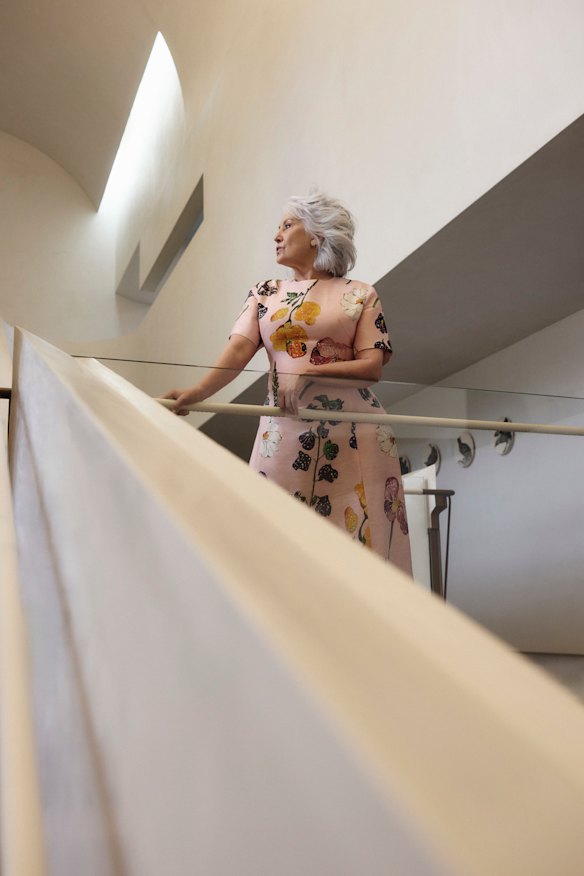
Neilson owns 15 buildings, including White Rabbit, Dangrove (an art storage facility “the size of two football fields”), two performance spaces and a private gallery next door to her home. Each building has a name. All have been architecturally designed to the highest creative standard, and custom-built for the purpose designated by Neilson.
Neilson’s brief to Smart for her home was, well, brief. She wanted the floors to be brick pavers, even though “everybody fought me on it ... they just hated the idea”.
She wanted the house to be easy for an elderly person to live in (Neilson is now 79, so it has a lift between its four levels, including the wine cellar), and minimal technology, although Neilson says the architects still “snuck” some gadgets in. She wanted the walls done in an Italian washed plaster style, and there were to be no curtains. “I absolutely hate curtains,” she says.
The house also has an outdoor reflection pool, a self-contained guest apartment off the stairwell, and geothermal heating and cooling which is remarkably effective – on the muggy, late-summer Sydney day of my visit, it is a cool 22 degrees inside. “Once we had the floor plan, William showed me different buildings around the world and I tended to go for ones that were monastery, cave-y sort of buildings,” she says.
You might hate everything in this house, but it’s my story, and you can’t have anybody coming in and changing it.
Judith NeilsonNeilson has two daughters, Paris and Beau Neilson, who visit occasionally with their children, so one of the four bedrooms is set up as a twin-bed room for grandkids. But usually, says Neilson, “it’s just the three of us”, referring to herself and her two beloved chihuahuas, Wasabi and Cumin.
I ask if it ever bothers her, having all this space to herself. “I love it,” she says. “It’s like being outside.”
Neilson had envisaged the place to be a centre for family, but, she says, “my children don’t have much to do with me”.
“I’d hoped for it to be, you know, family dinners and whatever [but] my kids are busy with their families,” she says. “My grandkids on one side do come … they love fiddling with everything here.”
Architecture is “just a tiny, tiny part of my indulgence”, says Neilson. “These buildings, I live in them and they get used for various things, but basically, they belong to the future, and the community.”
Neilson wants Indigo Slam to stay exactly as it is. “Because it’s a story of one person,” she explains. “You might hate everything in this house, but it’s my story, and you can’t have anybody coming in and changing it.”
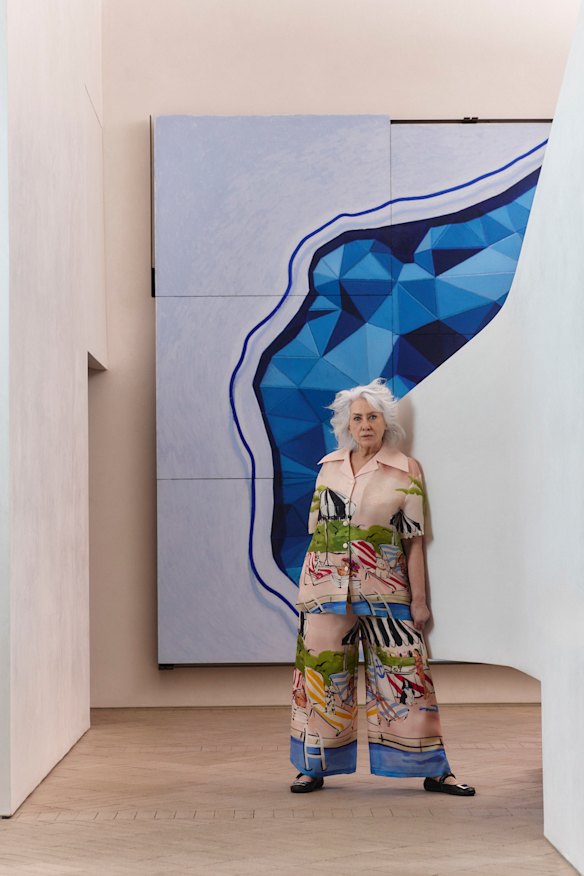
So she wouldn’t do the usual thing of bequeathing her house or other properties to her children? “No, no, no, absolutely no,” she says. “There’s an estate plan. These don’t just get given out to family and friends.”
Apart from her art collection, Neilson is probably best known for her philanthropy, for which she was awarded an Order of Australia in 2016. The Judith Neilson Foundation invests primarily in community-based initiatives in Africa and Australia.
“Coming from Africa, I’ve always contributed and helped when I could,” she says. “Even when I had very, very little, it’s always been there, and when I was able to do it on a larger scale, I just moved into it.”
Neilson was born in Bulawayo, Rhodesia (now Zimbabwe), in 1946, and grew up as one of four sisters. It was a barefoot childhood – her father was a mechanic who later specialised in making car radiators, and her mother was a teacher.
“Everything was humble and wonderful,” she says. “It was family. You enjoyed what you had. You never knew who would be spending the night at your place.”
Aged 17, Neilson went to study graphic art and textile design in Durban, South Africa. Later, after a brief stint back home, she returned to South Africa where she met and married her husband, Kerr Neilson. They immigrated to Australia in 1983, at a time when there was political instability throughout southern Africa.
“We thought, ‘If we are getting married, we should probably start at a place where we have some hope.’ Because we realised that it wasn’t our time [in Africa] any more. The whites were very, very, very privileged. It didn’t matter whether you were the lowest, poorest white, you were better off than the local people.”
This perspective on disadvantage has sharpened her philanthropic focus to women and girls, as well as support for refugees. Since the Trump administration has pulled funding from its USAID program, Neilson says, “we have had to put a hell of a lot extra” into the foundation’s African projects.
I ask her what she thinks of the current crop of American tech billionaires, and whether she believes they donate enough of their wealth.
“Sorry, you’re only rich because other people have made you rich,” she says sharply. “And you’ve been lucky. I absolutely think that you shouldn’t be taking it with you.”
Despite her age and stature as a collector, Neilson says she “still” feels like an outsider to the Australian art establishment. “I honestly, 100 per cent believe it’s racist because it’s Chinese art,” she says.
Neilson estimates she has visited a thousand artists’ studios over the last 25 years. She owns over 4000 pieces of Chinese art – “It’s historically invaluable,” she says. “China does not have a document like that” – as well as about a thousand pieces of African and Aboriginal art.
Neilson is particularly proud of the democratic nature of White Rabbit, which is free and open to all. “The ordinary Australian who wouldn’t normally go into a gallery, they should know that there is great art in Chippendale,” she says. “They can walk in and they can feel comfortable, and we tell everybody, ‘Whatever your opinion, it’s 100 per cent correct.’”
I ask her about the contentious debate around de-platforming certain artists for their political views. “Well, art is a voice,” she says. “So, if you don’t let people talk, you don’t know what’s going on.”
Another of Neilson’s initiatives, markedly less successful, was the Judith Neilson Institute for Journalism and Ideas. Founded in 2018 and funded with $100 million, Neilson had great hopes it would revive the fortunes of quality media in Australia. Instead, it collapsed in a morass of board resignations and acrimony.
“Well, I got hammered on that and it was totally unfair – they were always having conferences, and I mean, I have no idea,” she says of the Institute. “All I got from that whole thing is one ballpoint pen.”
The Institute has refocused its operations and is working on some “big projects”, Neilson says, though she won’t provide any information about them. “You’ll probably start seeing things in, I don’t know, maybe six months.”
After we finish our interview, Nielson takes me on a whirlwind tour of her private gallery, housed in a bespoke building next to her home. Spread over four floors, it has a dazzling collection of mostly African art and objects, including life-size puppets in traditional African costume and a pair of armchairs upholstered in tiny beading.
There are also dozens of pairs of a particular type of flip-flop, made from car tyres, that is commonly worn in Africa. They are displayed on their own shelf.
In the Neilson multiverse – of properties, charity initiatives, art, collectibles, journalism projects and other things of beauty – every object has its dignity, and its place.
“I’m a humble person,” she says. “And quite shy. The reason I do this is because there are so many people who can benefit, and it’s easier for them to find one Judith Neilson.”
Fashion editor: Penny McCarthy. Hair: Pete Lennon. Make-up: Aimie Fiebig using Sisley Paris. Fashion assistant: Liz Hoffman
Stockists: Alémais; Lee Mathews; Leo Lin; Roger Vivier.
Get the best of Sunday Life magazine delivered to your inbox every Sunday morning. Sign up here for our free newsletter.