
When Elias Manolis started experiencing extreme fatigue early last year, his parents were alarmed, but not surprised.
The 13-year-old from Long Island, New York, had been born with ureterovesical junction obstruction, a rare congenital disease, where a blockage between the ureter and bladder causes urine to back up into the kidney. The condition can cause pain, infections and fevers.
Rita Manolis said her son struggled with "a lot of infections, a lot of hospital visits, lots of surgeries" over the years. His symptoms led to limits on his diet and physical activity. As he grew, he often missed school and couldn't see his friends often. But still, the level of fatigue he reached in February 2025 was unusual.
"He didn't have the energy to do things normal kids would do, like getting up to go to school," Rita Manolis said. "Staying in school all day would be a mission for him. He'd come home just completely drained."
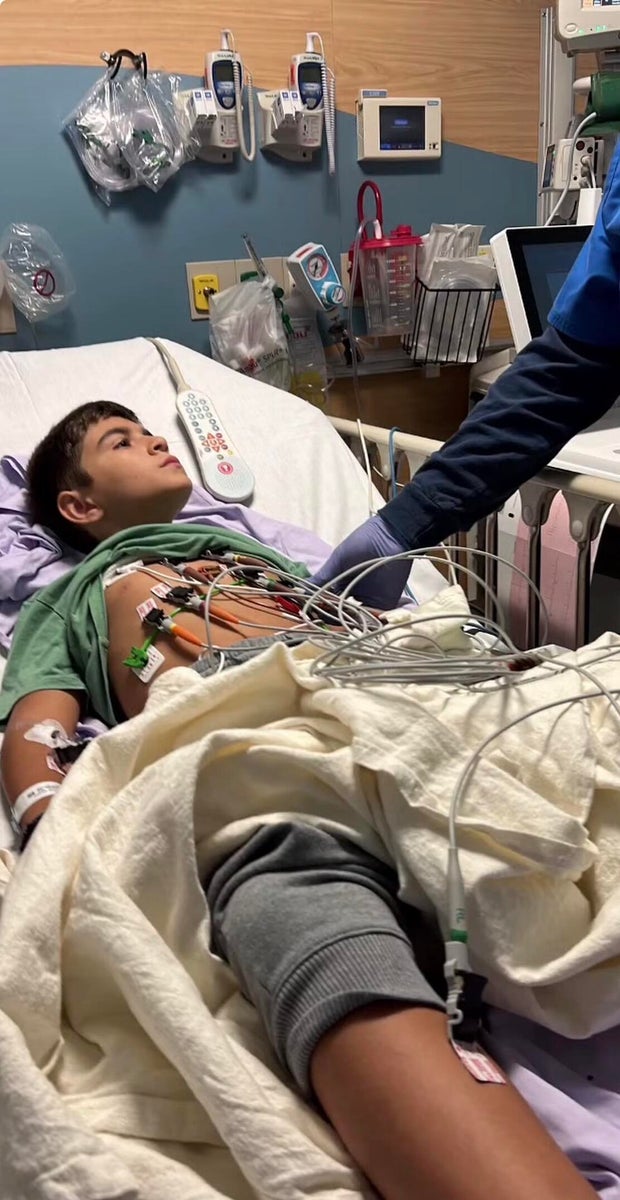 Elias Manolis in the hospital.
Rita Manolis
Elias Manolis in the hospital.
Rita Manolis
Elias' doctors recommended a kidney transplant. But there are far more people in need than there are organs available, according to the American Kidney Fund.
Rita Manolis was told her son might need to wait up to two years for an organ. She and her husband wanted to avoid the delay, and started their own donor search. They shared Elias' story on social media, worked with outreach organizations and spoke to local media. It felt like a race against time, Rita Manolis said.
"You could tell that he was just slowly deteriorating," Rita Manolis recalled.
"Drawn to try to help them"
Tim Fitzpatrick, a 44-year-old dad of two who is also from Long Island, learned about Elias' case — and it resonated with him. His older son has an immune disease called eosinophilic esophagitis, where white blood cells gather in the esophagus and cause issues with swallowing and breathing.
Fitzpatrick had recently become interested in registering as a living kidney donor, and his wife showed him a local news story about Elias.
"The more I read about his story and looked at what they've gone through, I related," Fitzpatrick said. "Being a medical parent, having this hopeless feeling of you want your son to be healthy, and you can't, you physically can't, do anything. I just felt drawn to try to help them."
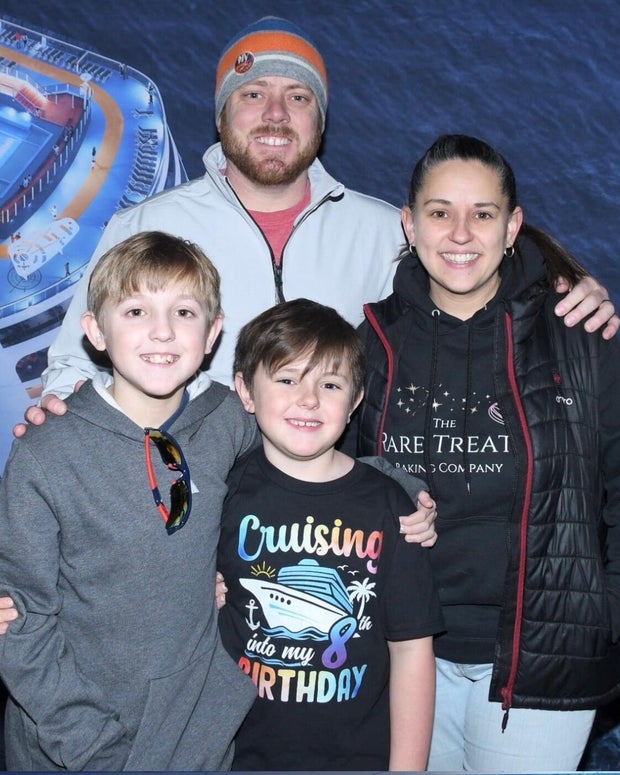 Tim and Stephanie Fitzpatrick with their two sons.
Tim and Stephanie Fitzpatrick
Tim and Stephanie Fitzpatrick with their two sons.
Tim and Stephanie Fitzpatrick
Testing at an area hospital confirmed that Fitzpatrick was a match for Elias. Finding out he could actually make a difference for the Manolis family "was a relief," Fitzpatrick said.
Having a living donor wouldn't just shorten the time Elias might spend waiting for an organ. It would also increase his chances of a better outcome, said NYU Langone nephrologist Dr. Laura Malaga-Diaz, who was part of Elias' care team. Kidneys from living donors also last longer than those from deceased donors, Malaga-Diaz said. Since Elias received the kidney at a young age, he will likely need future transplants. The longer the organ lasts, the less frequent those transplants will need to be, she said.
"It was just a happy feeling to finally give that family an answer and give them the hope they've been waiting for for 13 years," Fitzpatrick said.
"A light at the end of the tunnel"
Elias said he was "super happy" and "really excited" to be told there was a donor. His mother remembered "mixed emotions" of excitement and stress.
"We weren't expecting it," Rita Manolis said. "But when you do get the call, it's life-changing. You know that there's a light at the end of the tunnel."
Things moved quickly after the donation was confirmed. The Manolis family decided to do the procedure at NYU Langone. It felt even more like kismet for Fitzpatrick: His son had been receiving treatment at NYU Langone's Hassenfeld Children's Hospital for his entire life.
The surgeries took place on March 23. First, Fitzpatrick underwent a minimally invasive operation to remove his kidney through a small incision. Then it was taken to Elias' operating room and placed alongside his existing kidneys in a four-hour procedure. Everything went smoothly, surgeons Dr. Bruce Gelb and Dr. Jonathan Berger said.
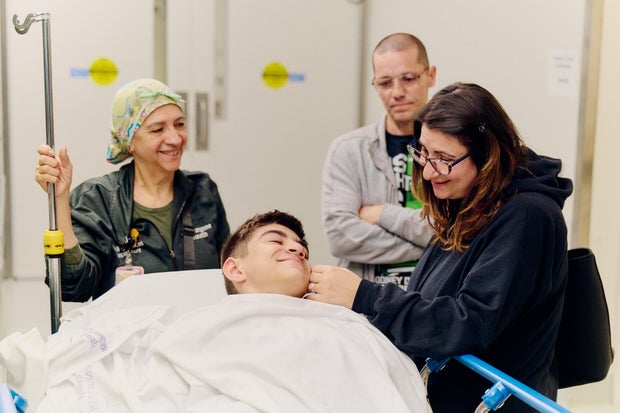 Elias Manolis is wheeled into surgery, with his mother Rita at his side.
Joe Carrotta/NYU Langone
Elias Manolis is wheeled into surgery, with his mother Rita at his side.
Joe Carrotta/NYU Langone
Because of the minimally invasive procedure, Fitzpatrick was discharged the day after his surgery. Before he left, he visited Elias' hospital room. It was the first time the two had met. Fitzpatrick's wife Stephanie brought cookies, while Elias handed Fitzpatrick a letter thanking him for his donation.
It was an emotional moment, both families said.
"I don't think there was a dry eye in the room," said Rita Manolis.
"Part of our family"
Elias was discharged from the hospital five days later, and is now recovering well, Berger said. He will take immunosuppression medication for the rest of his life, and is currently in isolation to protect his new organ. But he should be able to live a "totally normal life" soon, Berger said.
"Elias is going to go back to school. He's going to play sports if he wants. He's going to be able to hang out with his friends, he's going to be able to eat junk food," said Berger. "He's going to be able to do all the things that you'd want a 13-year-old to do."
Rita Manolis said that for the first time, her son has normal kidney function. Elias said that this summer, he is looking forward to riding his bike and eating his favorite food: "A big, juicy red steak."
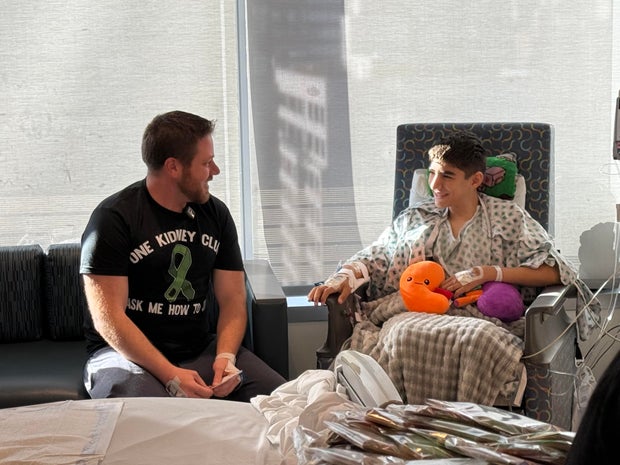 Tim Fitzpatrick and Elias Manolis.
NYU Langone
Tim Fitzpatrick and Elias Manolis.
NYU Langone
The Manolises and the Fitzpatricks might just enjoy that steak together. The two families discovered that they live just minutes from each other, and have stayed in touch. The Fitzpatrick children are close in age to Elias. Manolis and Stephanie Fitzpatrick talk regularly. The families are now making plans for a backyard barbecue.
"Tim is a part of (Elias), with him everywhere he goes," Stephanie Fitzpatrick said. "It's really special to see that connection there, and to see that this relationship exists, and that we will, in a sense, have another family. They're part of our family."
Edited by Sarah Lynch Baldwin
In:

















































